
Multi Flow Condenser vs Serpentine Condenser: Which Design Wins on Efficiency?
Posted on November 23, 2026
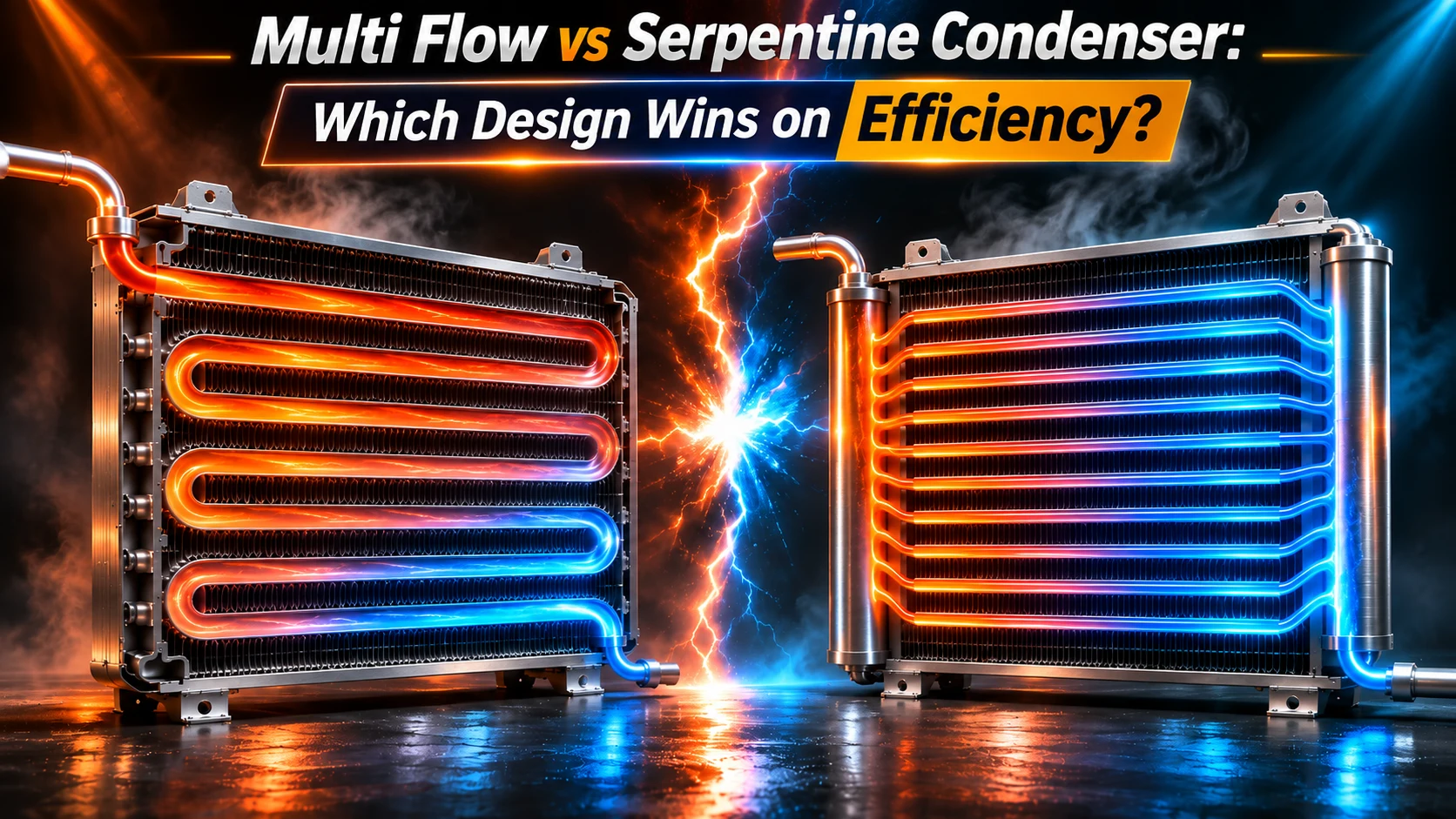
Two condensers sit side by side on a workbench. Same footprint. Same fin pitch. Similar price. To the eye, they are twins.
Fit them to identical systems on a 45°C day and they can behave very differently. One holds the condensing temperature steady. The other lets head pressure creep up and drags efficiency down with it.
The difference is hidden inside: how the refrigerant travels through the coil. A Multi Flow Condenser splits it across many parallel tubes. A serpentine condenser sends it down one long, winding path.
So, which design actually performs better? And does the newer technology always win?
Let’s break it down.
Short answer: A well-engineered Multi Flow Condenser usually wins on pressure drop, compactness and heat transfer in medium- to high-capacity systems. A serpentine condenser can still be the smarter choice for small, low-capacity duties where a simple circuit and low internal volume matter. Neither design wins everywhere.
What Really Separates the Two Designs?
Both condensers do the same job. They take hot, high-pressure vapour from the compressor, pass it through tubes while air flows over the fins, and turn it into liquid, often with a little subcooling on the way out.
The difference is the path the refrigerant takes:
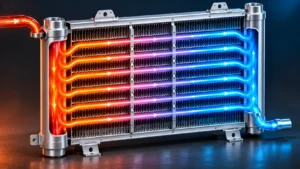
- Multi Flow Condenser: Refrigerant enters a header, and baffles divide the flat tubes into passes. The refrigerant moves through several tubes at the same time. When those flat tubes contain many tiny internal ports, you have a Multi channel condenser, commonly called an MCHX condenser.
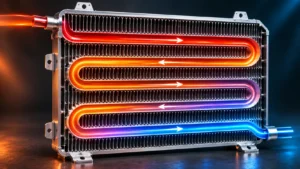
- Serpentine condenser: One long flat tube, sometimes two, is bent back and forth in a zig-zag, with fins sitting between the bends. Every bit of refrigerant follows the same single route from inlet to outlet.
That one design choice shapes pressure drop, refrigerant distribution, size and weight. If you want the deeper theory on parallel circuits, our guide on multi flow vs parallel flow condensers covers it.
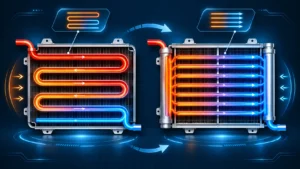
Multi Flow vs Serpentine Condenser at a Glance
| Feature | Multi Flow Condenser | Serpentine Condenser |
| Refrigerant path | Several parallel paths between headers | One long, winding path |
| Construction | Flat tubes, headers and baffles | Single folded tube with fins between bends |
| Pressure drop | Lower in well-designed circuits | Rises as the path gets longer |
| Heat transfer in tight spaces | Strong | Good when sized for the duty |
| Refrigerant charge | Typically low in microchannel designs | Can be low in compact coils |
| Distribution risk | Uneven flow between tubes if poorly designed | None, as there is only one path |
| Best suited to | Automotive, bus, HVAC, industrial cooling | Small refrigeration duties, some replacement parts |
The Good News: Newer Doesn’t Automatically Mean Better
It is easy to assume the parallel design always beats the serpentine one. Early automotive studies did find parallel-flow condensers delivering higher heat transfer with lower flow resistance and less refrigerant than serpentine units.
But that doesn’t make serpentine outdated.
A properly sized serpentine coil can outperform a poorly designed multi-flow coil. What counts is whether the condenser rejects the required heat at an acceptable pressure drop, airflow, size and refrigerant charge.
Where Multi Flow Condensers Pull Ahead
A Multi Flow Condenser tends to win when:
- Heat load is high and the coil has to stay compact
- Pressure drop matters, because splitting the flow shortens each refrigerant path
- Weight is a concern, as all-aluminium construction keeps units light
- Refrigerant charge needs to stay low, thanks to small internal volume
- The circuit must scale, since pass arrangements can be tuned for different capacities
This is why the design is so common in automotive air conditioning, bus cooling and modern HVAC equipment.
Where Serpentine Condensers Still Hold Their Own
A serpentine condenser makes sense when:
- The duty is small and long-path pressure drop stays manageable
- The circuit needs to be simple, with no baffles or large headers
- Distribution can’t go wrong, because the refrigerant has only one route
- Internal volume must stay low in a compact coil
- You are replacing an existing unit that was designed around a serpentine layout
Here’s a useful rule of thumb:
High capacity + tight space + pressure drop matters = look at a Multi Flow Condenser.
Small duty + simple circuit + low internal volume = a serpentine condenser may be enough.
It isn’t a substitute for proper sizing calculations, but it gives you a far better starting point.
The Catch: Pressure Drop and Refrigerant Distribution
Every design has a weak spot, and these two have opposite ones.
In a serpentine condenser, refrigerant has to push through a long path full of bends. The longer the circuit, the more friction, and the more pressure the system loses before the refrigerant ever reaches the outlet.
In a Multi Flow Condenser, each path is shorter, but the refrigerant has to split evenly. If header design or baffle placement is poor, some tubes get flooded while others carry very little flow. Those starved tubes barely contribute to heat rejection, so the condenser underperforms on paper-perfect specifications.
That’s why the layout label alone tells you very little. Engineering quality decides the result.
What Else Shapes Real-World Performance?
Even the best layout can be held back by the conditions around it:
- Airflow: Blocked fins or poor ventilation can cut capacity sharply.
- Ambient temperature: Hotter air reduces the temperature difference that drives heat rejection.
- Refrigerant and operating pressure: These influence tube selection and circuit design.
- Fin design and brazing quality: Poor joints mean poor heat transfer and weaker durability.
Why the Wrong Choice Gets Expensive
This isn’t just a technical debate. It’s about efficiency, downtime and replacement cost.
Choosing a serpentine coil for a heavy duty
Condensing temperature climbs, the compressor works harder, and energy use goes up. The system may still run, but it won’t run efficiently.
Choosing a multi-flow coil without checking serviceability
Microchannel passages are tiny. After a compressor failure, contamination can be hard to flush out, and replacing the coil is often the practical answer. Our guide on cleaning and maintaining a microchannel condenser coil explains what can and can’t be cleaned.
For OEMs and fleet operators, one wrong specification multiplied across hundreds of units is a costly mistake.
5 Questions to Ask Before You Choose
- How much heat does the system need to reject?
Size the condenser for the real duty at peak conditions, not the average day. - Which refrigerant and operating pressure are you using?
Both affect tube design, circuit layout and safety requirements. - How much space and weight can you spare?
Tight packaging usually favours multi-flow. Simple, small installations may not need it. - What airflow and ambient temperature will the coil face?
A high-performance condenser still needs air. - How harsh is the environment?
Dust, humidity, vibration and salt exposure all influence which design lasts and how easy it is to clean.
Where Each Design Is Commonly Used
Multi Flow Condensers are widely used in passenger vehicle AC, bus and transport AC, commercial refrigeration, HVAC equipment and industrial cooling, where capacity, weight and space are all under pressure.
Serpentine condensers remain relevant in compact refrigeration equipment, older automotive systems and selected replacement applications.
Why the Manufacturer Matters as Much as the Design
A good design on paper means little if the tube geometry, header distribution, brazing and leak testing aren’t right. Two condensers with the same drawing can perform very differently on the road or in the plant.
As an MCHX condenser manufacturer India buyers can consider, NBR Cooling Systems builds microchannel and multi-flow condensers for automotive, HVAC, refrigeration and industrial applications, with controlled-atmosphere brazing, helium leak testing, and IATF 16949 and ISO 9001:2015 certifications behind its production.
For custom requirements, working with a team like nbrcoolingsystem lets heat-rejection capacity, refrigerant, dimensions and operating conditions be considered together, rather than one at a time. You can also explore the wider range of aluminium condensers.
Better design match → lower pressure losses → steadier head pressure → more efficient, reliable cooling.
The Bottom Line
A Multi Flow Condenser is usually the stronger choice when you need high capacity, compact packaging and lower pressure drop, which is why it dominates modern automotive, HVAC and transport cooling. A serpentine condenser still earns its place in small, simple systems where its single-path design and low internal volume are enough. The real question isn’t which technology is newer, but which one is engineered for your duty, your refrigerant, your airflow and your operating environment. Get that match right and the condenser quietly does its job. Get it wrong and the cost shows up in energy bills, compressor wear and downtime.
FAQs
What is the main difference between a Multi Flow Condenser and a serpentine condenser?
A Multi Flow Condenser sends refrigerant through several parallel tubes connected to headers, while a serpentine condenser sends it through one long, winding tube. This affects pressure drop, refrigerant distribution and heat transfer.
Is a Multi Flow Condenser more efficient than a serpentine condenser?
Often, yes, especially in compact, high-capacity systems. But efficiency also depends on sizing, airflow, refrigerant and operating conditions, so a well-matched serpentine coil can outperform a poorly designed multi-flow one.
Is a multi-flow condenser the same as a parallel-flow condenser?
The terms are commonly used for the same general design, where refrigerant is distributed through multiple parallel paths. Circuit details vary between manufacturers.
What is a Multi channel condenser?
A Multi channel condenser uses flat tubes with many small internal passages. It is the construction behind most MCHX condensers and supports compact, lightweight heat rejection.
Which condenser has lower pressure drop and refrigerant charge?
Multi-flow designs generally offer lower pressure drop because flow is divided between paths, and microchannel versions usually carry a small charge. Compact serpentine coils can also have low internal volume, so check the manufacturer’s specifications instead of assuming.
Are serpentine condensers still used today?
Yes. They remain common in compact refrigeration equipment and in replacement parts for older automotive systems, where their simple circuit is an advantage.
Need a condenser matched to your cooling duty? Talk to the team at NBR Cooling Systems.