
Multi Flow Condenser vs Parallel Flow Condenser: Are They Actually Different?
Posted on May 19, 2026
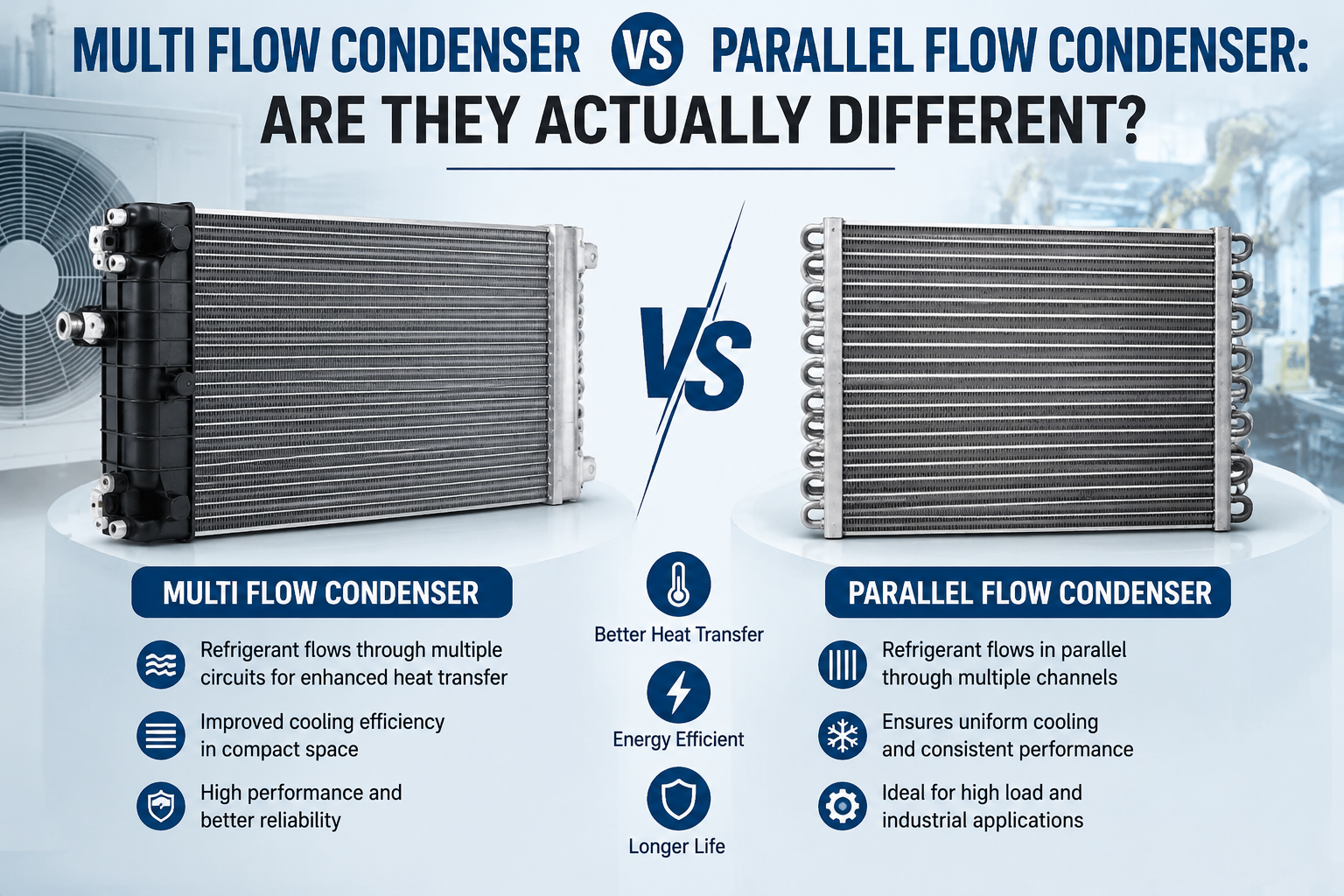
Multi Flow Condenser technology has transformed modern cooling systems by improving heat transfer efficiency, reducing energy consumption, and supporting compact system designs. Although Multi Flow Condenser and Parallel Flow Condenser technologies appear similar, they differ in construction, refrigerant flow, and cooling performance. This blog explores their major differences, applications, and which option is better suited for modern cooling requirements.
Understanding Modern Condenser Technology
Older condensers used larger tubes and fin designs, which made cooling systems heavier and less efficient. Modern cooling systems now require condensers that are compact, lightweight, and capable of delivering faster and better cooling performance.
To meet these requirements, advanced condenser technologies were developed with improved refrigerant flow and heat transfer capabilities. Modern condensers mainly focus on:
- Better cooling efficiency
- Faster heat transfer
- Lower energy consumption
- Compact and lightweight design
- Improved overall system performance
One popular solution is the Multi Flow Condenser, which is designed to provide efficient cooling while reducing system size and refrigerant usage. It is widely used in automotive AC systems and industrial cooling applications.
Another widely used option is the Parallel Flow Condenser, which improves refrigerant distribution through multiple channels for stable and consistent cooling.
Although both technologies are designed for better cooling efficiency, they differ in internal structure, refrigerant flow, and overall performance.
What is a Parallel Flow Condenser?
A Parallel Flow Condenser is a heat exchanger designed with multiple flat tubes arranged in parallel paths. Refrigerant enters the condenser and distributes evenly through these channels, allowing heat to dissipate rapidly through aluminum fins.
Key Features of Parallel Flow Condensers
- Lightweight aluminum construction
- High heat transfer efficiency
- Reduced refrigerant charge requirement
- Compact and space-saving design
- Faster cooling performance
- Better airflow optimization
These condensers are commonly found in:
- Passenger vehicles
- Heavy commercial vehicles
- HVAC systems
- Refrigeration equipment
- Industrial cooling units
The parallel channel structure improves refrigerant distribution and minimizes pressure drops, making the system more energy efficient.
How Multi-Flow Technology Differs
While the working principle may appear similar, multi-flow designs often incorporate more advanced refrigerant routing methods and optimized channel arrangements.
The primary objective is to increase surface contact between refrigerant and cooling fins while maintaining compact dimensions. This allows the condenser to deliver superior cooling efficiency even under high thermal loads.
In many modern automotive and industrial applications, manufacturers prefer this design because it supports:
- Faster thermal exchange
- Better cooling stability
- Reduced compressor workload
- Improved fuel efficiency in vehicles
- Lower operational energy consumption
The internal tube design can also vary depending on system requirements, pressure ratings, and refrigerant type.
Structural Comparison
Below is a simplified comparison graph explaining the differences between the two condenser technologies.
| Feature | Multi-Flow Design | Parallel Flow Design |
|---|---|---|
| Refrigerant Distribution | Optimized multi-path routing | Uniform parallel channels |
| Cooling Efficiency | Very High | High |
| Heat Transfer Rate | Faster under heavy load | Consistent and stable |
| Weight | Lightweight | Lightweight |
| Space Requirement | Compact | Compact |
| Energy Efficiency | Excellent | Very Good |
| Automotive Usage | Widely preferred | Commonly used |
| Industrial Applications | Advanced systems | Standard systems |
| Airflow Optimization | Enhanced | Good |
| Refrigerant Volume | Lower | Moderate |
Performance Comparison
1. Heat Transfer Capability
Multi-flow designs generally perform better in high-temperature conditions because refrigerant flow is optimized across multiple pathways. This improves cooling efficiency and reduces thermal stress.
Parallel flow systems also provide excellent heat transfer but may perform slightly lower under extreme operational loads.
2. System Size and Weight
Both designs are lightweight and compact compared to traditional serpentine condensers. However, multi-flow systems are often engineered with more advanced compact configurations.
This is especially useful in modern automobiles where space optimization is critical.
3. Energy Efficiency
Because of better thermal performance, advanced multi-path designs can reduce compressor load, indirectly improving energy efficiency and vehicle fuel economy.
Parallel flow condensers are also energy efficient but may require slightly higher refrigerant balancing in some systems.
4. Durability and Reliability
Modern aluminum condenser systems are built for corrosion resistance and long operational life. Proper maintenance and airflow management are essential for maximizing durability.
Both technologies offer reliable performance when used in suitable applications.
Role of Advanced Heat Exchanger Technologies
Modern cooling systems increasingly rely on advanced heat exchanger concepts for improved thermal management.
One such innovation is the MCHX condenser, which enhances heat dissipation through highly compact micro-channel structures. These systems are designed for high efficiency while minimizing material usage and overall system weight.
Similarly, the Micro channel condense technology used in several modern cooling systems improves refrigerant distribution and heat transfer efficiency. Its compact structure supports better airflow and superior thermal performance.
Another commonly used solution is the Multi channel condenser, which utilizes multiple refrigerant pathways to optimize cooling consistency and operational efficiency.
These innovations collectively contribute to reduced energy consumption, improved cooling capacity, and better system reliability across automotive and industrial applications.
Which One is Better?
The answer depends entirely on the application.
Choose Multi-Flow Technology If You Need:
- Higher cooling efficiency
- Better performance in demanding environments
- Improved energy savings
- Compact high-performance systems
- Enhanced thermal management
Choose Parallel Flow Technology If You Need:
- Reliable everyday cooling performance
- Cost-effective heat exchange solutions
- Stable refrigerant distribution
- Lightweight condenser systems
- Proven automotive cooling efficiency
Both technologies are highly efficient compared to traditional condenser systems. The final choice depends on cooling requirements, operating conditions, available space, and energy efficiency goals.
Final Thoughts
Although they share several similarities, Multi Flow Condenser and Parallel Flow Condenser technologies are not exactly the same. Both systems are designed to improve cooling performance, but they differ in refrigerant routing, thermal efficiency optimization, and application-specific advantages.
As industries continue demanding smaller, lighter, and more efficient cooling solutions, advanced condenser technologies will keep evolving. Whether used in automobiles, industrial machinery, or HVAC systems, these modern designs provide better heat transfer, improved energy savings, and enhanced operational reliability.
Understanding the differences between these condenser systems helps businesses and manufacturers select the most suitable solution for their cooling applications while ensuring long-term efficiency and performance.
FAQ’S
1. Is a Multi Flow Condenser the same as a Parallel Flow Condenser?
Not exactly. A Parallel Flow Condenser mainly describes the refrigerant flow arrangement where refrigerant moves through parallel tubes simultaneously, while a Multi flow condenser refers to the advanced structural design using multiple micro passages for improved heat transfer. In modern systems, both technologies are often combined together for maximum cooling efficiency.
2. Why are Micro channel condensers more efficient than traditional condensers?
A Micro channel condenser uses extremely small refrigerant passages that increase surface contact area and improve heat dissipation. This allows faster cooling, reduced refrigerant usage, and improved thermal efficiency compared to traditional tube-and-fin condensers.
3. Can a Multi Flow Condenser be flushed after compressor failure?
In most cases, technicians recommend replacing rather than flushing a Multi flow condenser because the micro passages are extremely small and can easily trap debris or metal particles after compressor damage.