
Why Do Industrial Condensers Fail? Top 10 Causes and Prevention Tips
Posted on July 23, 2026
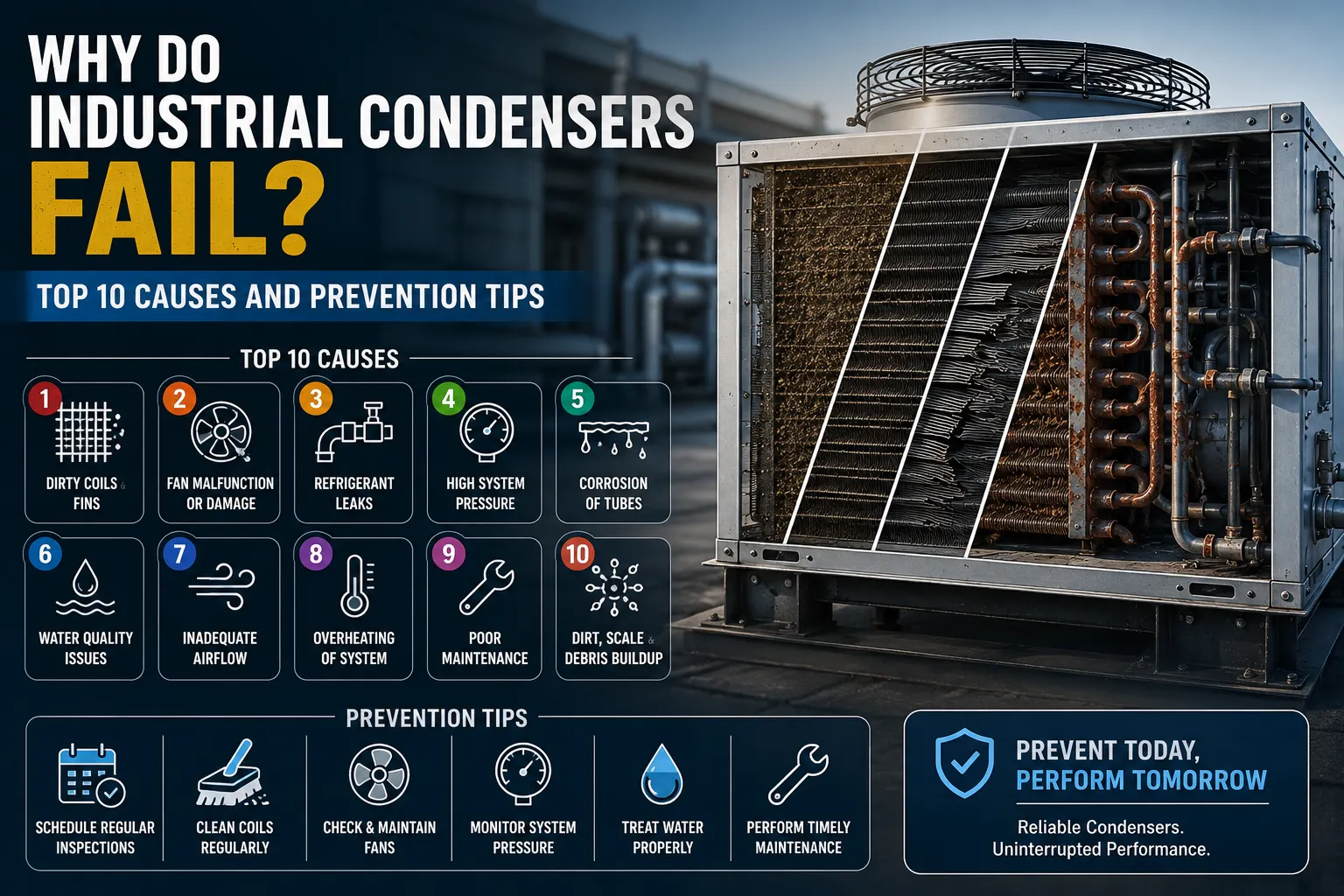
Industrial condensers are the backbone of HVAC, refrigeration, and industrial cooling systems. From manufacturing plants and cold storage facilities to chemical processing units and commercial buildings, these systems play a crucial role in removing heat and maintaining stable operating temperatures. When an industrial condenser performs efficiently, the entire cooling system operates smoothly. However, even a minor issue within the condenser can quickly lead to reduced cooling capacity, increased energy consumption, higher operating costs, and unexpected equipment downtime.
The good news is that most condenser failures don’t occur suddenly. They usually develop over time due to poor maintenance, environmental conditions, or operational mistakes that are often preventable. By understanding the most common causes of failure, industries can take proactive measures to improve system performance, reduce repair costs, and extend equipment life.
In this article, we’ll discuss the ten most common reasons industrial condensers fail and share practical prevention tips that can help keep your cooling systems operating at peak efficiency.
1. Dirty Condenser Coils
If there’s one issue responsible for the majority of condenser failures, it’s dirty condenser coils.
As the system operates, dust, grease, dirt, and airborne contaminants gradually settle on the condenser coils. This layer acts as insulation, preventing efficient heat transfer and forcing the condenser to work much harder than intended. As heat rejection becomes less effective, the compressor experiences additional stress, resulting in increased energy consumption and reduced cooling performance.
Ignoring dirty coils for extended periods can eventually lead to compressor damage and costly system failures.
Common Signs
- Reduced cooling performance
- Higher electricity bills
- Increased operating pressure
- Overheating compressor
Prevention Tip: Schedule regular condenser coil cleaning based on your operating environment. Facilities exposed to dust or industrial pollutants may require cleaning every few months, while cleaner environments may only need annual maintenance.
2. Poor Airflow Around the Condenser
An industrial condenser depends on proper airflow to release heat efficiently. Even if the condenser itself is in excellent condition, blocked airflow can significantly reduce its performance.
Obstructed ventilation, damaged condenser fans, equipment installed too close to walls, or debris surrounding the unit all make it difficult for heat to escape. This increases operating temperatures and places unnecessary stress on the entire cooling system.
Common Causes
- Blocked air passages
- Faulty condenser fans
- Poor installation location
- Dust buildup around the equipment
Prevention Tip: Maintain adequate clearance around the condenser and inspect fan motors regularly to ensure unrestricted airflow.
3. Refrigerant Leaks
Refrigerant plays a critical role in transferring heat throughout the cooling system. Even a small leak can reduce system efficiency and force the compressor to run longer to achieve the desired cooling output.
Many businesses simply recharge refrigerant without identifying the actual leak. While this may temporarily restore cooling performance, the underlying issue continues to worsen until major repairs become necessary.
Warning Signs
- Poor cooling efficiency
- Low refrigerant pressure
- Ice formation on system components
- Longer compressor operating cycles
Prevention Tip: Conduct routine leak inspections and repair leaks immediately rather than repeatedly adding refrigerant.
4. Corrosion of Condenser Components
Industrial condensers often operate in harsh environments where moisture, chemicals, and airborne contaminants accelerate corrosion.
Over time, corrosion weakens condenser tubes, fins, and structural components, reducing heat transfer efficiency and increasing the likelihood of refrigerant leaks. In severe cases, corrosion can require complete coil replacement.
Facilities located near coastal regions or chemical plants are especially vulnerable.
Prevention Tip: Use corrosion-resistant condenser materials and include corrosion inspections as part of every preventive maintenance schedule.
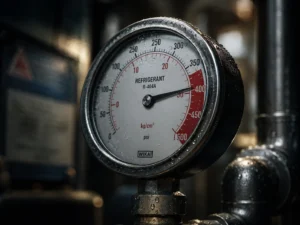
5. High Operating Pressure
High condenser pressure isn’t usually the main problem—it’s often a sign that something else in the system isn’t working correctly.
Dirty coils, poor airflow, refrigerant issues, or high ambient temperatures commonly cause pressure to rise beyond recommended limits. If ignored, excessive pressure places additional stress on compressors, valves, and piping, shortening the life of the entire cooling system.
Prevention Tip: Instead of simply lowering system pressure, identify and resolve the root cause before it leads to more serious equipment damage.
6. Lack of Preventive Maintenance
Many industrial condenser failures happen simply because routine maintenance is delayed or skipped.
Small issues like loose electrical connections, worn fan motors, or partially blocked coils are inexpensive to fix when identified early. Without regular inspections, these minor problems gradually develop into major equipment failures that result in costly downtime.
A proper maintenance schedule should include:
- Condenser coil cleaning
- Fan inspection
- Refrigerant leak testing
- Pressure monitoring
- Electrical connection inspection
- Overall system performance evaluation
Preventive maintenance is one of the most effective ways to improve equipment reliability while reducing long-term operating costs.
7. Poor Installation Practices
Even the highest-quality condenser can experience premature failure if it isn’t installed correctly.
Improper refrigerant piping, incorrect equipment sizing, inadequate ventilation clearance, unstable mounting surfaces, and poor electrical wiring all reduce system performance and increase the likelihood of breakdowns.
Professional installation ensures every component operates within its intended design specifications.
Prevention Tip: Always have industrial cooling equipment installed and commissioned by qualified professionals.
8. Selecting the Wrong Condenser for the Application
Every industry has unique cooling requirements. A condenser that performs well in one application may not be suitable for another.
Choosing equipment based only on price or availability often results in oversized or undersized systems that operate inefficiently and experience excessive wear.
Working with an experienced Industrial Condenser Manufacturer helps ensure the condenser is properly designed for the required cooling capacity, operating conditions, and industrial application.
9. Scale Buildup in Water-Cooled Condensers
For water-cooled industrial condensers, mineral deposits are another common cause of reduced efficiency.
Hard water gradually forms scale inside condenser tubes, restricting water flow and reducing heat transfer. Unlike dirty air-cooled coils, scale buildup often remains unnoticed until cooling performance begins to decline.
Warning Signs
- Gradually increasing operating pressure
- Reduced water flow
- Higher energy consumption
- Declining cooling efficiency
Prevention Tip: Monitor water quality regularly and implement proper water treatment programs to minimize mineral deposits.
10. Aging Equipment
No industrial equipment lasts forever.
Even well-maintained condensers naturally lose efficiency as they age. Components wear out, corrosion becomes more common, and repairs become increasingly frequent.
Instead of repeatedly repairing aging equipment, businesses should evaluate whether replacement offers a better long-term return on investment.
Signs Your Condenser May Need Replacement
- Frequent breakdowns
- Increasing repair costs
- Reduced cooling performance
- Higher energy consumption
- Recurring refrigerant leaks
Prevention Tip: Compare annual maintenance costs with replacement costs to determine the most cost-effective solution.
How Regular Maintenance Prevents Costly Downtime
Preventive maintenance isn’t just about avoiding equipment failures—it’s about improving the overall efficiency and reliability of your cooling system.
By following a consistent maintenance schedule, businesses can:
- Improve energy efficiency
- Reduce unexpected equipment breakdowns
- Extend condenser service life
- Lower repair and maintenance expenses
- Maintain consistent cooling performance
- Improve overall plant productivity
A proactive maintenance approach always costs less than emergency repairs and production downtime.
Best Practices to Keep Industrial Condensers Running Efficiently
To maximize condenser performance and reliability:
- Clean condenser coils regularly.
- Keep airflow around the condenser unrestricted.
- Repair refrigerant leaks as soon as they’re detected.
- Monitor operating pressure consistently.
- Replace worn fans and damaged components promptly.
- Follow a preventive maintenance schedule.
- Inspect electrical connections periodically.
- Maintain detailed service records for every condenser.
- Monitor water quality in water-cooled systems.
- Choose equipment specifically designed for your operating environment.
Why Choosing the Right Supplier Matters
Regular maintenance is essential, but the long-term reliability of any cooling system also depends on the quality of the equipment itself.
Partnering with a trusted Condenser Supplier ensures you receive equipment that’s engineered for your application rather than relying on standard solutions that may not meet your operational requirements. The right supplier also provides technical expertise, reliable support, and customized cooling solutions that improve performance over the life of the equipment.
Final Thoughts
Industrial condenser failures rarely happen without warning. In most cases, they’re the result of preventable issues such as dirty coils, poor airflow, refrigerant leaks, corrosion, improper installation, or neglected maintenance. Recognizing these warning signs early allows businesses to reduce downtime, improve energy efficiency, and significantly extend equipment life.
Whether you’re upgrading an existing cooling system or installing a new one, investing in high-quality equipment and following a proactive maintenance strategy will deliver long-term operational benefits.
At NBR Cooling Systems, we understand that every industrial application has unique cooling requirements. That’s why we design reliable, high-performance condenser solutions that help industries improve efficiency, reduce maintenance costs, and achieve dependable performance for years to come.
FAQ’s
How often should industrial condenser coils be cleaned?
As a baseline, once a year is standard for facilities in clean, low-dust environments. In dusty, coastal, or heavily polluted industrial settings, that interval should drop to every 3–6 months, since buildup accumulates far faster in those conditions.
What are the first signs of a failing condenser?
The earliest warning signs are usually a noticeable drop in cooling performance, rising energy bills without any change in usage, ice forming on refrigerant lines, and the compressor running longer or louder than normal. Catching these early is almost always cheaper than waiting for a full breakdown.
How much does a dirty condenser coil actually cost in energy?
More than most people expect. A dirty coil can force the compressor to use up to 30% more energy to deliver the same cooling output, since it’s compensating for blocked heat transfer rather than an actual increase in cooling demand.
Can a refrigerant leak be fixed by just adding more refrigerant?
No — and this is one of the most common (and costly) mistakes. Topping up refrigerant without locating and repairing the actual leak only masks the symptom temporarily. The leak keeps growing, and the eventual repair usually ends up bigger and more expensive than if it had been fixed immediately.
What’s considered high operating pressure for an industrial condenser?
It depends on the refrigerant and ambient conditions, but as a general reference, a properly charged system typically runs in the 300–450 PSIG range on the high side during normal warm-weather operation. Pressure that climbs well above that isn’t usually the root problem itself — it’s almost always a downstream sign of dirty coils, blocked airflow, or a refrigerant issue.
How long do industrial condensers typically last?
With consistent maintenance, well-maintained industrial condensers commonly run reliably for 15–20 years. Units in harsh operating environments or with inconsistent maintenance histories often fall well short of that range.
Is it better to repair or replace an old condenser?
There’s no fixed rule, but a useful signal is repair frequency and cost trending upward year over year. Once annual repair costs start approaching a meaningful share of replacement cost, it’s usually worth running the numbers on a new, properly specified unit instead of continuing to patch an aging one.
Do water-cooled condensers fail differently than air-cooled ones?
Yes — water-cooled units have a failure mode air-cooled systems don’t: mineral scale buildup inside the tubes from hard water. Unlike dirty air-cooled coils, which are visible from the outside, scale forms internally and often goes unnoticed until cooling performance has already started declining.
What’s the difference between a symptom and a root cause when diagnosing condenser problems?
High pressure, reduced cooling, and rising energy bills are almost always symptoms, not root causes. The actual root cause is typically one of a handful of things: dirty coils, blocked airflow, a refrigerant leak, corrosion, or scale — fixing the symptom (like just lowering pressure) without addressing the underlying cause usually means the problem returns.