
Roof-Mounted vs Under-Floor Bus AC Condenser: Which Survives Indian Roads Better?
Posted on October 27, 2026

Ask a fleet owner in Indore and a coach builder in Pune where a bus AC condenser belongs, and you’ll get two confident, opposite answers. Same bus, same AC, same job, so is somebody wrong? Not quite, and not entirely. The mounting spot decides how often you clean it, how soon it fails, and how your cooling holds up at the next traffic signal. Let’s clear it up, no jargon, no guesswork.
The One-Sentence Version
On most Indian routes, a roof-mounted condenser survives better, while an under-floor one keeps the bus lower and more stable. Roof units breathe cleaner air and dodge the mud and debris. Under-floor units win on weight placement and shade, but they live in the line of fire. Your road decides the winner, not the brochure.
First, Why Does a Bus AC Condenser Need So Much Care?
A bus AC doesn’t create cold. It moves heat out of the cabin, and the condenser is where that heat leaves. To do that job it needs two things: clean airflow and cool air. If either is restricted, pressure climbs, cooling drops, and the compressor works harder than it should.
Now add Indian conditions: 40°C-plus summers, fine dust, monsoon splash, potholes, speed breakers and long stretches of stop-and-go traffic. Where you mount the condenser decides how much of that punishment it takes.
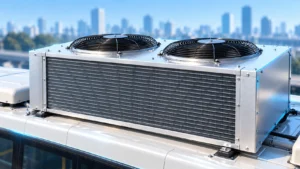
Meet the Roof-Mounted Condenser: The Clean-Air Specialist
The condenser sits on top of the bus, well above the dust cloud kicked up by tyres and traffic. It’s the usual choice on city and mid-size buses.
What it does well: the intake air is cleaner and usually cooler than air near the road, it stays clear of mud, water splash and stones, and it frees space under the floor for luggage.
What it costs you: extra weight and height up high, which raises the centre of gravity and cuts clearance under flyovers and branches. It also takes direct sun, amplifies vibration on its mounts, and is awkward to reach, so cleaning tends to get postponed.
Meet the Under-Floor Condenser: The Low-and-Stable Option
The condenser sits in the luggage bay or skirt area, low on the bus. It’s more common on larger coaches.
What it does well: it keeps the weight low, stays shaded from direct sun, adds no roof height, and is easier for a technician to reach.
What it costs you: it sits in the splash zone, so dust, mud and chaff reach the fins first. The air near the ground can be hot from the tarmac, stones and plastic bags find it quickly, constant moisture speeds up corrosion, and in tight underbody space hot air can be pulled straight back in during slow traffic.
In simple terms:
- Roof-mounted: cleaner air, less road damage, but more weight and vibration up high.
- Under-floor: lower and shaded, but dirtier, wetter and more exposed.
- Neither is a free pass. Both need a condenser built for the job.

The Difference That Actually Matters: Exposure and Airflow
Here’s where choosing gets real. The label matters less than two questions: how clean is the air reaching the fins, and how much punishment does the coil take every day?
A roof condenser trades dirt exposure for height and vibration. An under-floor condenser trades stability for dirt, water and impact. On a dusty highway with a monsoon stretch, the roof usually comes out ahead. On a smooth, dry intercity route, an under-floor unit with a good guard can work well.
Neither is better everywhere. Route, climate and bus type decide.
What Really Decides Survival on Indian Roads
Mounting position sets the battlefield, but build quality decides the fight. Engineers look at heat rejection (how much heat leaves) together with airflow resistance (how freely air passes through). A coil that rejects heat well but clogs quickly, or one that blocks airflow, gains you nothing in traffic.
Weight, corrosion resistance and fin design matter just as much. A lighter core softens the penalty of roof mounting, a good coating protects an under-floor unit in wet or coastal air, and fins that shed dust stay effective between services.
This is why the micro channel condenser has become so popular for buses. It’s lighter, holds less refrigerant, and its all-aluminium build resists the galvanic corrosion that hits mixed-metal designs. They’re hard to patch, so gentle cleaning matters. Our guide on how to properly clean and maintain a microchannel condenser coil covers it step by step.
When Your Condenser Is Quietly Struggling
A struggling condenser doesn’t always announce itself. You might notice cooling that fades at traffic lights but recovers at speed, rising discharge pressure, the compressor tripping on its high-pressure cut-off, oily residue on the coil, bent or blocked fins, or fans running slowly.
Before you replace anything, remember the same symptoms can come from low refrigerant, a blocked receiver-drier or a weak fan motor. Inspect and check pressures first. It saves money.
What This Means When You’re Buying One
Here’s the part most buyers miss: the mounting position on the quote matters less than whether the condenser was engineered for your bus. Two units that look alike can have very different cores, fan setups and coatings. A good supplier will ask for your bus model, mounting position, cooling capacity, fan voltage, available dimensions and route conditions before quoting.
It also pays to buy from a proper bus air conditioning condenser manufacturer India operators trust, one that designs around real heat rejection and Indian operating conditions, not one that simply matches a catalogue size.
NBR’s Take: Build It for the Road, Not the Brochure
That’s the thinking behind how nbrcoolingsystem approaches bus condensers: built around the route, the climate and the mounting position, not just a size on a spec sheet. NBR also offers OEM manufacturing to your drawings, which helps when an off-the-shelf unit won’t fit your bus layout. To compare options, start with the Bus ac condenser range and share your bus model and capacity.
Same Bus, Different Mounting
Roof-mounted and under-floor condensers do the same job: they push heat out of the cabin so the AC can keep working. What differs is the life each one lives. The roof protects the coil from dirt, water and impact at the cost of height and vibration, while the floor keeps the weight low at the cost of constant exposure. On most Indian routes the roof earns the edge, but the best outcome comes from matching the position to your road, choosing a light, corrosion-resistant design, and cleaning it before it asks. Pick on those, and the mounting label stops being the argument.
FAQs
Is a roof-mounted or under-floor bus AC condenser better in India?
Roof-mounted is usually better, because it gets cleaner air and avoids mud, splash and debris. Under-floor suits larger coaches where a low centre of gravity matters, if it is guarded and cleaned regularly.
Why does bus AC cool on the highway but not at traffic lights?
At speed, air is forced through the condenser. In traffic, the system relies on the fans and clean fins, so a dirty condenser or weak fan shows up as weaker cooling.
Why do under-floor condensers clog faster?
They sit where tyres throw dust, mud and chaff, and moisture holds that dirt on the fins, which restricts airflow.
Do roof-mounted condensers have any downsides?
Yes. They add weight and height, take direct sun, amplify vibration on the mounts and are harder to reach for cleaning.
Are micro channel condensers good for buses?
Generally yes. They are lighter, use less refrigerant and resist corrosion, though damaged cores are usually replaced rather than repaired.
How often should a bus AC condenser be cleaned?
It depends on the route. Dusty, muddy or monsoon-heavy routes need it more often, and under-floor units usually need it sooner. After any muddy trip is a good trigger.
What are the signs of a failing bus AC condenser?
Weak cooling in traffic, high discharge pressure, compressor trips, oily residue and bent or blocked fins. Since other faults look similar, inspect and check pressures first.
How do I choose a bus AC condenser manufacturer?
Look at their engineering support, core range, testing and quality control, and whether they can build to your bus model and drawings. Accurate bus and route details help them recommend the right unit.