Microchannel Condenser Types Explained: The 3 Cooling Methods, 3 Coil Layouts, and Which One Fits Your System
Posted on October 12, 2026
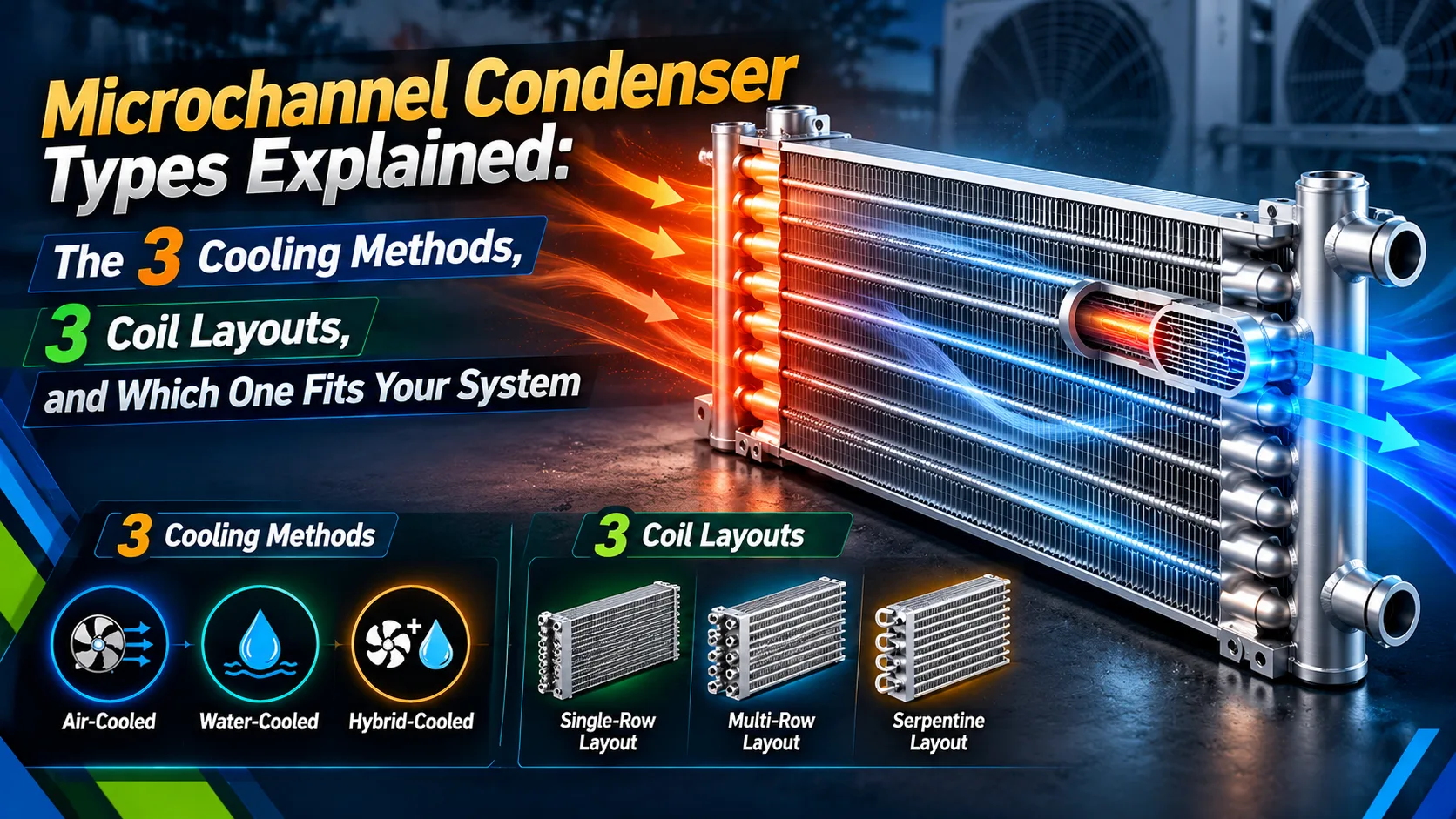
If you’ve searched microchannel condenser ” types,” you’ve probably seen two very different answers. Some guides list air-cooled, water-cooled, and evaporative condensers. Others talk about parallel-flow and serpentine coils. Both are correct, because they answer different questions.
- The cooling method tells you what carries the heat away (air, water, or evaporating water).
- The coil layout tells you how refrigerant moves through the condenser.
A micro channel condenser sits in the first group as an air-cooled design, and it is classified by layout in the second. This guide covers both, so nothing is left to guesswork.
What Is a Microchannel Condenser?
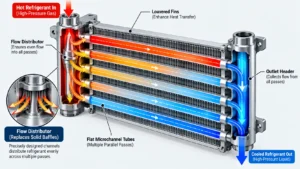
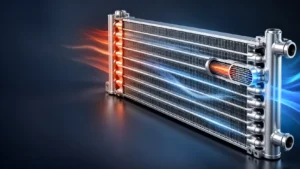
A condenser’s job is to take hot, high-pressure refrigerant vapor from the compressor and turn it back into liquid by rejecting heat. A microchannel condenser does this with flat, multi-port aluminium tubes and louvered fins instead of round tubes threaded through fins. Each flat tube is divided into many small internal passages, which is why you’ll also see the technology called a multi channel condenser.
Technical literature describes these tubes as having internal webs that split each tube into several longitudinal flow passages, which increases heat transfer in a smaller package.
Why manufacturers and system designers choose them:
- Compact and lightweight, thanks to thin aluminium construction
- Lower refrigerant charge, because internal volume is small. One coil manufacturer reports cutting internal volume by around 40% in parallel-flow propane coils by using narrow multi-port tubes and small-diameter manifolds
- All-aluminium construction, which avoids the copper-to-aluminium contact that can drive galvanic corrosion in traditional coils
- Good fit for tight spaces, from rooftop units to vehicle air-conditioning
Where Are Microchannel Condensers Used?
- Residential and commercial air conditioners
- Automotive and bus air-conditioning (the parallel-flow condenser is widely used in automotive A/C and is a typical microchannel design)
- Commercial refrigeration and refrigerated display cases
- Heat pumps and compact cooling assemblies
- Light industrial and process cooling equipment
The 3 Types of Condensers by Cooling Method
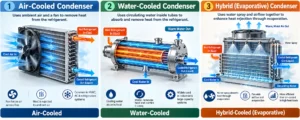
Every condenser, microchannel or not, falls into one of three groups depending on what absorbs the heat.
1. Air-Cooled Condensers
Air passes over the condenser coil and carries the heat away. No water is needed.
There are two sub-types:
- Natural convection (static): Air moves over the coil only because warm air rises and cooler air replaces it. Airflow is low, so this suits small systems like household refrigerators.
- Forced convection (fan-driven): A fan pushes or pulls air across the coil. This gives much higher heat rejection and is used in air conditioners, commercial refrigeration, and vehicle systems.
Where microchannel fits: Microchannel condensers are air-cooled, and in practice they are fan-driven (forced convection).
Advantages:
- No water supply or treatment needed
- Lower installation complexity and maintenance
- Works where water is scarce or expensive
Limit: Performance depends on ambient air temperature. On very hot days, condensing temperature rises and compressors work harder.
2. Water-Cooled Condensers
Water absorbs the heat from the refrigerant, and that warm water is typically sent to a cooling tower or drain. Water-cooled condensers are common in larger systems where a reliable water supply exists.
There are three common constructions:
- Double-tube (tube-in-tube): One tube sits inside another. Refrigerant and water flow in separate tubes.
- Shell-and-coil: A coil of water tubing sits inside a sealed shell filled with refrigerant.
- Shell-and-tube: Water flows through many tubes inside a cylindrical shell, with refrigerant around them.
Advantages: Stable, low condensing temperatures, compact for large duties.
Limits: Needs a water supply, water treatment, and more upkeep than air-cooled units.
3. Evaporative Condensers
Water is sprayed over the condenser coil while a fan moves air across it. Some of the water evaporates, and evaporation absorbs a large amount of heat. That lets the condenser reach lower condensing temperatures than air-cooled equipment, and it uses less water than once-through water cooling.
Where it fits: Large industrial refrigeration systems and hot climates.
Limits: Still uses water, and requires treatment, cleaning, and monitoring.
Quick Comparison
| Air-Cooled | Water-Cooled | Evaporative | |
| Heat carried away by | Air | Water | Air plus evaporating water |
| Water needed? | No | Yes | Yes (less than once-through) |
| Upkeep | Lowest | Highest | Medium to high |
| Typical scale | Small to large | Medium to large | Large industrial |
| Microchannel fit | Yes | No | No |
The practical takeaway: If you are specifying a microchannel condenser, you are choosing an air-cooled design. The question that remains is which coil layout suits your system.
The 3 Microchannel Coil Layouts
Once you’ve chosen air-cooled microchannel, the layout is the next decision. These are the three layouts worth knowing.
Layout 1: Parallel-Flow (Header-and-Tube)
Two header pipes sit at either end of a bank of flat tubes. Refrigerant enters one header, spreads across many tubes at once, and collects in the other. In multi-pass versions, baffles inside the headers divide the tubes into banks: refrigerant flows in parallel within a bank and in series from one bank to the next.
- Best for: Medium to large duties, automotive and bus A/C, HVAC units
- Watch-out: Research on multi-pass parallel-flow condensers notes that performance can suffer from uneven refrigerant distribution caused by pressure drop in the headers
Layout 2: Serpentine
A long flat multi-port tube is folded back and forth like a ribbon. In one published modelling study, a serpentine condenser used two flat tubes with 10 turns and 11 passes. Serpentine coils can be built with minimal or no large manifolds, which keeps internal volume low.
A coil manufacturer’s technical note compares a parallel-flow coil with about 0.1 litre of internal volume (roughly 3 kW duty, under 300 x 300 mm) to a same-size serpentine coil at about 0.05 litre. That lower volume means a lower refrigerant charge, useful for flammable refrigerants like propane.
- Best for: Compact refrigeration, display cabinets, small to mid-capacity systems (the same manufacturer positions serpentine for roughly up to 8 kW)
- Watch-out: Long single flow paths can raise pressure drop if the design isn’t matched to the duty
Layout 3: Advanced Multi-Pass (Flow-Distributor Designs)
These are refinements of parallel-flow aimed at its main weakness: uneven flow.
- Multiple parallel-pass (MPP) condensers: One or more baffles in the header are replaced with flow distributors, so refrigerant flows in parallel between adjacent passes. A published design paper describes this as a way to enlarge the two-phase zone, improve condensation heat transfer, and reduce pressure drop.
- Liquid-vapor separation designs: One experimental study found that at small mass fluxes, a separation design had a lower heat transfer coefficient than a common parallel-flow condenser under the tested conditions, so these aren’t automatic upgrades.
- Best for: Custom OEM projects with a well-defined duty
- Reality check: Much of the public evidence comes from patents and research papers, so treat this as an engineering option to discuss with a manufacturer, not an off-the-shelf category
Layout Comparison
| Parallel-Flow | Serpentine | Advanced Multi-Pass | |
| Layout | Headers + many flat tubes | One long folded tube | Parallel-flow with flow distributors |
| Typical duty | Medium to large | Small to medium | Application-specific |
| Refrigerant charge | Moderate | Lower | Varies |
| Main strength | Scalable capacity | Low charge, compact | Better flow balance |
| Main risk | Header maldistribution | Pressure drop on long paths | Complexity |
How to Choose: 6 Questions to Ask
- Do you have a water supply?
If not, air-cooled microchannel is the natural choice. - What’s your heat rejection duty?
Higher duties point toward parallel-flow. Small duties open the door to serpentine. - Which refrigerant are you using?
Flammable or charge-limited refrigerants favour low-volume designs. - How much space and airflow do you have?
Microchannel’s thin profile helps in tight enclosures, but it still needs adequate airflow. - What’s the environment?
Dusty, coastal, or debris-heavy sites need a coil that can be cleaned safely. Microchannel fins are delicate, so soft brushing and low-pressure rinsing are the norm. - Is this standard or custom?
Standard duties can use catalogue coils. Unusual duties may justify an engineered circuit.
Choosing a Condenser Manufacturer for HVAC
A condenser is only as reliable as the process behind it. When comparing a condenser manufacturer for HVAC, ask:
- Which coil layout do you recommend for my duty, and why?
- What refrigerants is the coil rated for?
- How is each coil tested before dispatch (for example, leak and pressure testing)?
- Can you match the coil to my dimensions and mounting?
- What support is available for sizing and replacements?
Where NBR Cooling Systems Fits In
NBR Cooling Systems, based in Indore, India, supplies microchannel (MCHX) condensers alongside domestic air-conditioner condensers, bus AC condensers, and aluminium AC condensers, plus oil coolers and other heat exchangers. Because the right layout depends on your specification, share your duty, refrigerant, space, and operating conditions with the NBR Cooling Systems team and confirm the exact configuration for your application before ordering.
The Bottom Line
“Types of microchannel condensers” has two correct answers. By cooling method, a microchannel condenser is an air-cooled design, one of the three condenser families alongside water-cooled and evaporative. By coil layout, your options are parallel-flow, serpentine, and advanced multi-pass. Match the layout to your duty, refrigerant, and space, and ask your manufacturer to explain the reasoning behind their recommendation.
FAQ’s
What is a micro channel condenser?
A condenser built from flat aluminium tubes with many small internal passages and louvered fins. It rejects heat from refrigerant into air in a compact, lightweight package.
Is a multi channel condenser the same as a microchannel condenser?
In practice, yes. Both describe condensers built from multi-port flat tubes.
What are the 3 types of condensers?
By cooling method: air-cooled, water-cooled, and evaporative. Microchannel condensers belong to the air-cooled group.
Is a microchannel condenser air-cooled or water-cooled?
Air-cooled. Air passes over the finned flat tubes, typically driven by a fan.
What are the main coil layouts for microchannel condensers?
Parallel-flow (header-and-tube, often multi-pass), serpentine, and advanced multi-pass designs with flow distributors.
Which layout uses the least refrigerant?
Serpentine designs are built for low internal volume, so they suit low-charge applications, though the right choice still depends on duty.
How should a microchannel condenser be cleaned?
Gently. Use a soft brush in the direction of the fins and low-pressure water, and follow the manufacturer’s guidance on any chemical cleaners.
Where are microchannel condensers used?
In air conditioners, automotive and bus A/C, commercial refrigeration, heat pumps, and compact cooling equipment.