
Types of Condensers Used in Industrial Applications (Air vs Water-Cooled)
Posted on February 16, 2026
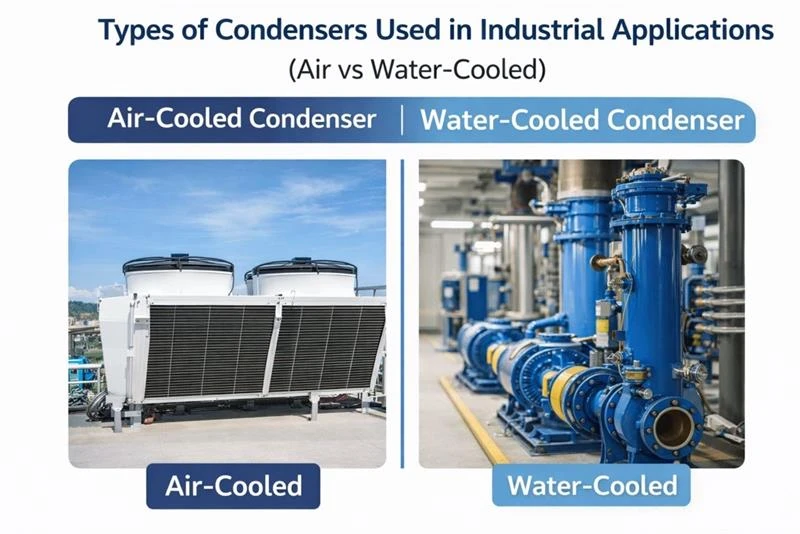
In industrial cooling and refrigeration systems, condensers play a critical role in maintaining operational efficiency and system stability. Whether used in HVAC systems, power plants, manufacturing units, chemical processing facilities, or heavy-duty equipment, condensers ensure that heat is effectively removed from the system to keep processes running smoothly.
Among the various designs available, air-cooled and water-cooled condensers are the most widely used in industrial applications. Each offers unique advantages depending on operating conditions, energy efficiency goals, maintenance considerations, and installation environments.
In this guide, we’ll break down how both types work, compare their benefits, and help you determine which is best suited for your industrial application.
What Is a Condenser and Why Is It Important?
A condenser is a heat exchanger that removes heat from a vapor or fluid, converting it into a liquid state through heat dissipation. In refrigeration and cooling systems, condensers release heat absorbed during compression, enabling the cycle to continue efficiently.
In industrial applications, condensers help:
-
Maintain system stability
-
Improve energy efficiency
-
Prevent overheating
-
Enhance equipment lifespan
-
Reduce operational downtime
Choosing the right condenser type is essential for long-term performance and cost savings.
How Industrial Condensers Work
Industrial condensers operate on the principle of heat transfer. Hot refrigerant vapor enters the condenser, where heat is transferred to an external cooling medium (air or water). As heat is removed, the vapor condenses into liquid form and returns to the system for reuse.
The effectiveness of this process depends on:
-
Heat load capacity
-
Cooling medium efficiency
-
Surface area design
-
Flow rate
-
Ambient operating conditions
Types of Condensers Used in Industrial Applications
1. Air-Cooled Condensers
Air-cooled condensers use ambient air as the cooling medium to remove heat from refrigerant vapor.
How Air-Cooled Condensers Work
In these systems:
-
Hot refrigerant enters the condenser coils.
-
Fans force ambient air across the coils.
-
Heat transfers from the refrigerant to the air.
-
Refrigerant condenses into liquid form.
Key Features
-
Fin-and-tube design
-
Forced airflow via fans
-
Compact and modular structure
Advantages of Air-Cooled Condensers
Easy installation
Lower water consumption
Minimal maintenance
Ideal for water-scarce regions
Cost-effective for small to medium operations
Limitations
Lower efficiency in high ambient temperatures
Higher energy use due to fan operation
Noise levels may be higher
Common Applications
-
Industrial HVAC systems
-
Refrigeration plants
-
Gensets
-
Light manufacturing facilities
2. Water-Cooled Condensers
Water-cooled condensers use water as the cooling medium, offering higher efficiency in large-scale industrial operations.
How Water-Cooled Condensers Work
In water-cooled systems:
-
Hot refrigerant flows into the condenser.
-
Cooling water circulates through tubes or shells.
-
Heat transfers to water.
-
Refrigerant condenses and exits the system.
Types of Water-Cooled Condensers
-
Shell and Tube Condensers – Most common in industry
-
Shell and Coil Condensers – Compact designs
-
Tube-in-Tube Condensers – Smaller applications
Advantages
Higher cooling efficiency
Better performance in hot climates
Lower operating noise
Suitable for large heat loads
Limitations
Requires a consistent water supply
Higher installation cost
Regular maintenance needed
Scaling and corrosion risks
Common Applications
-
Power plants
-
Chemical processing units
-
Large manufacturing facilities
-
Marine systems
Air-Cooled vs Water-Cooled Condensers: Key Differences
Cooling Efficiency
Water-cooled condensers generally offer higher heat rejection efficiency compared to air-cooled systems, especially under heavy industrial loads.
Installation Requirements
Air-cooled units are easier to install and require less infrastructure, while water-cooled systems need piping, pumps, and cooling towers.
Operating Cost
Air-cooled systems have lower installation costs but may consume more electricity due to fan operation. Water-cooled systems can be more energy-efficient but incur water and maintenance costs.
Maintenance Needs
Air-cooled condensers require periodic cleaning of fins, while water-cooled systems demand more maintenance due to scaling and corrosion risks.
Environmental Considerations
Air-cooled systems conserve water, making them suitable for regions with limited water resources.
Factors to Consider When Choosing Between Air & Water-Cooled Condensers
1. Heat Load Requirements
Large-scale industrial processes benefit from water-cooled systems due to higher heat rejection capacity.
2. Operating Environment
Hot climates favor water-cooled systems, while dry regions benefit from air-cooled options.
3. Space Availability
Air-cooled systems require open space for airflow, whereas water-cooled systems require mechanical infrastructure.
4. Budget Considerations
Evaluate both upfront investment and long-term operational costs.
5. Water Availability
If water supply is limited or expensive, air-cooled systems are the better choice.
Emerging Trends in Industrial Condensers
Modern industrial condensers are evolving with:
-
High-efficiency fin designs
-
Corrosion-resistant materials
-
Advanced manufacturing techniques
-
Energy-saving fan technologies
-
Smart monitoring systems
These innovations help industries improve performance while reducing operational costs.
Why Choosing the Right Manufacturer Matters
Selecting a reliable condenser manufacturer ensures:
-
Customized solutions for specific applications
-
Optimized heat transfer design
-
High-quality materials and construction
-
Long-term durability
-
Strong after-sales support
Partnering with an experienced manufacturer ensures consistent performance and operational reliability.
Conclusion
Both air-cooled and water-cooled condensers play vital roles in industrial cooling systems. While air-cooled condensers offer simplicity and lower infrastructure requirements, water-cooled condensers deliver superior efficiency for heavy-duty operations.
The right choice depends on your application, environment, budget, and cooling demands. By carefully evaluating these factors and working with an experienced manufacturer, industries can achieve optimal performance, energy efficiency, and long-term reliability.
FAQs
1. Which condenser is more efficient: air-cooled or water-cooled?
Water-cooled condensers are generally more efficient for large industrial applications.
2. Are air-cooled condensers cheaper?
Yes, they typically have lower installation costs but may have higher operating costs.
3. Where are water-cooled condensers commonly used?
They are widely used in power plants, chemical industries, and large-scale manufacturing.
4. Do air-cooled condensers need maintenance?
Yes, regular cleaning of fins and fans is required for efficiency.
5. How do I choose the right condenser?
Consider heat load, operating environment, budget, and water availability before deciding.