
Condenser vs. Compressor: What’s the Actual Difference?
Posted on August 27, 2026
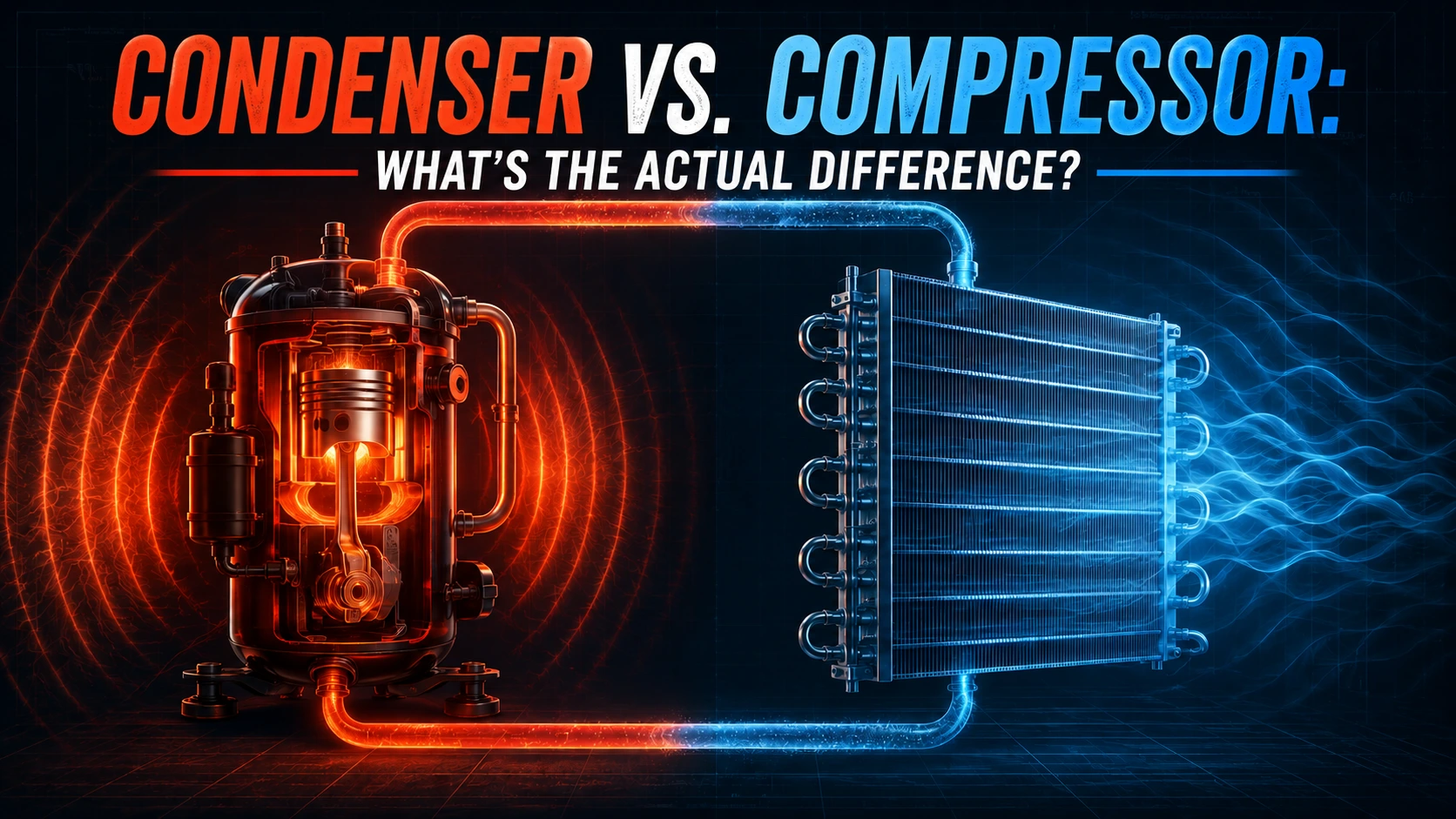
Ask ten people what’s humming away in their outdoor AC unit, and nine will confidently say “the compressor” — like that’s the whole story. It’s not even close. Sitting right next to it, quietly doing an equally critical job, is a part most people couldn’t name if their comfort depended on it. Which, honestly, it does. Mix these two up and you’ll misread a technician’s diagnosis, misunderstand a repair quote, and completely misjudge what’s actually broken when your house won’t cool down. Let’s fix that — no jargon, no guesswork, just the real story.
The One-Sentence Version
The compressor is the pump. The condenser is the radiator. One squeezes the refrigerant and shoves it forward. The other cools it back down and turns it back into liquid. Neither can do the other’s job. Take either one out, and you’ve got an expensive box that blows warm air and does nothing else.
Meet the Compressor — The Heart That Never Stops Working
Picture the compressor as the heart of the whole operation, because that’s genuinely how HVAC techs talk about it. Refrigerant shows up cool and low-pressure. The compressor’s entire job is to squeeze it — hard — cranking up both its pressure and its temperature, then shove it forward as a hot, high-pressure gas ready for its next stop.
Take the compressor out of the equation and you don’t have a weaker AC unit. You have a fan. That’s it. No matter how good everything else is built, nothing moves, nothing compresses, nothing cools. This is exactly why, when the compressor dies, the whole system usually just… stops. Not a gradual decline. A full stop.

Meet the Condenser — The Part Everyone Forgets Exists
Here’s where the mix-up usually happens. The condenser lives right beside the compressor, tucked into the same outdoor box — which is precisely why most people assume it’s one part doing double duty, or don’t even realize there’s a second component in there at all.
But its job couldn’t be more different. The condenser is a heat exchanger. It takes that scorching, high-pressure gas the compressor just created and cools it down through coils and a fan, dumping all that absorbed heat straight into the outside air. As it cools, the gas gives up and turns back into liquid — and that liquid heads off to finish the cooling cycle.
In simple terms:
- The compressor raises the pressure and heat.
- The condenser gets rid of that heat and turns the gas back into liquid.
One builds up energy. The other releases it.
Why This Actually Matters to You, Not Just Technicians
This isn’t a distinction that only matters to HVAC technicians.
Knowing the difference can completely change how you understand what’s going wrong with your system.
If your compressor fails:
The whole system will typically stop working properly.
You may experience:
- No cooling at all
- The outdoor unit not running properly
- The entire refrigeration cycle coming to a stop
If your condenser is dirty, damaged, or blocked:
Your system doesn’t necessarily stop completely.
Instead, it may struggle to release heat properly, resulting in:
- Weaker cooling
- Lower efficiency
- Higher energy consumption
- Extra strain on the system
- Lukewarm air instead of properly cooled air
Knowing which symptoms point toward which component means you’re not walking into a service call completely blind.
It also means you can better understand what a technician is telling you instead of simply nodding along.

Teammates, Not Rivals
Let’s be clear: this was never a “which one matters more” competition. The compressor and condenser are two halves of the exact same cycle, joined at the hip. The compressor loads the refrigerant up with pressure and heat. The condenser immediately steps in and strips that heat away. Skip either step and the whole cycle collapses — doesn’t matter how well-built the rest of your system is, it simply won’t cool.
What This Means When You’re Actually Buying Equipment
Here’s the part most buyers miss: a poorly built condenser can quietly sabotage an excellent compressor. Heat that doesn’t escape efficiently gets shoved right back onto the rest of the system, straining it, shortening its life, and driving your energy bill up in the process. That’s exactly why choosing an experienced condenser manufacturer for HVAC matters just as much as picking the right compressor — a condenser engineered for real heat-transfer performance, not just built to squeak past a minimum spec, is what lets everything downstream actually work the way it’s supposed to.
NBR’s Take: Build the Condenser Like It’s the Bottleneck It Could Be
This is exactly the mindset behind how NBR Cooling System builds every condenser — treating it like the make-or-break performance component it actually is, not a passive box of coils bolted next to the “important part.” As an experienced HVAC condenser manufacturer, NBR engineers every unit around genuine heat-rejection performance, so nothing downstream — compressor included — is left fighting a bottleneck it never should have had to deal with.
No Weak Links Allowed
The compressor and condenser were never interchangeable words for “that outdoor thing.” They’re two distinct components running two distinct jobs inside one shared cycle. The compressor pressurizes and moves the refrigerant. The condenser cools it back into liquid by dumping heat outdoors. Both deserve real maintenance, and both need to be genuinely well-built — because one weak link anywhere in that chain drags the whole system down with it. Sourcing your equipment from a genuine condenser manufacturer for HVAC systems isn’t a footnote decision. It’s the difference between a system that runs strong for years and one that’s quietly struggling from the day it’s installed.
Frequently Asked Questions
Is the condenser the same thing as the compressor?
No — they’re two separate components working as a team. The compressor pressurizes and circulates the refrigerant; the condenser cools that pressurized refrigerant back into liquid by releasing heat outdoors.
Which one is more important, the compressor or the condenser?
Neither — they’re both essential parts of the same cycle. Lose the compressor and the whole system usually stops. Let the condenser get dirty or damaged, and the system keeps running but struggles to actually cool.
Are the compressor and condenser in the same unit?
In most residential and commercial split systems, yes — they both live in the outdoor unit, which is exactly why people so often mix the two up or assume they’re one part.
What happens if my condenser coil gets dirty?
It gets harder for the system to release heat, which drags down cooling efficiency, drives up energy use, and puts extra strain on your compressor over time.
How can I tell if my compressor or condenser is the problem?
Is the whole system suddenly dead? Compressor’s the usual suspect. Still running but blowing weak, lukewarm air? That points more toward the condenser — though a real inspection always beats guessing.
Can a bad condenser cause a compressor to fail?
Yes. A faulty or dirty condenser can make it harder for the system to release heat, increasing pressure and forcing the compressor to work harder. Over time, this added stress and overheating can contribute to compressor failure.
Why is my AC running but not cooling—is it the condenser or compressor?
Yes, it could be either. A dirty or faulty condenser may prevent heat from escaping, while a failing compressor may be unable to circulate refrigerant properly. Other issues, such as low refrigerant or a faulty fan, can also cause the AC to run without cooling.
Should I replace just the compressor or the entire condenser unit?
It depends on the system’s age, condition, and repair cost. Replacing only the compressor can be cost-effective for a newer, well-maintained unit, while replacing the entire condenser may be a better long-term option for an older or inefficient system.