
Bar and Plate Heat Exchanger vs. Extruded Tube Heat Exchanger: Let’s Cut Through the Confusion
Posted on June 25, 2026
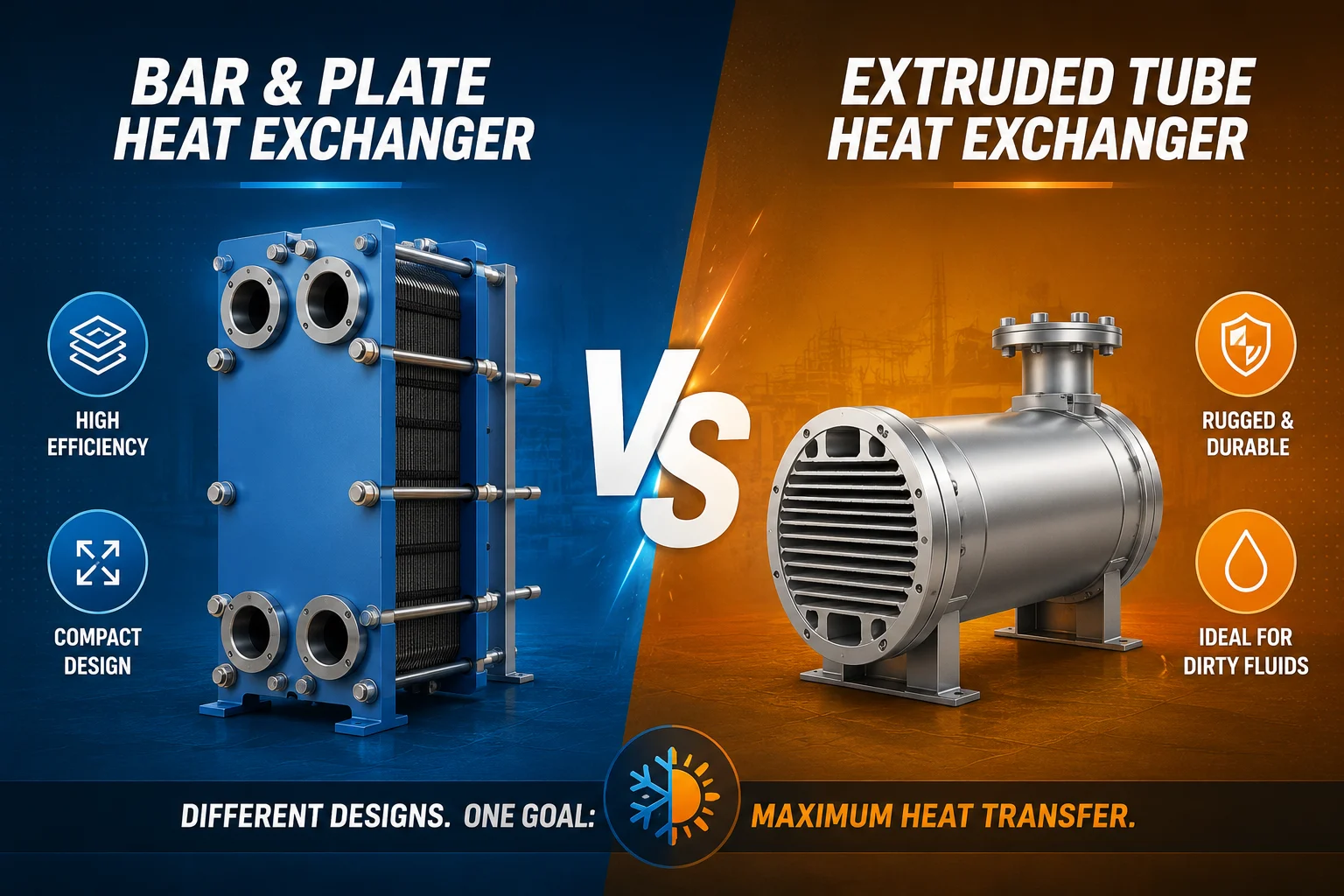
Selecting the right heat exchanger is critical for achieving efficient thermal management, lower operating costs, and long-term equipment reliability. Among the various technologies available today, the Bar and Plate Heat Exchanger and the Extruded Tube Heat Exchanger are frequently compared for industrial cooling applications.
While both technologies are designed to transfer heat effectively, their construction, efficiency levels, and application suitability differ significantly. Understanding these differences can help businesses choose the most suitable solution for their specific requirements.
What Is a Bar and Plate Heat Exchanger?
A Bar and Plate Heat Exchanger is a compact aluminum heat exchanger manufactured using plates, bars, and fins that are vacuum brazed together. This structure creates multiple flow channels, maximizing the heat transfer surface area while maintaining a lightweight design.
The Bar and Plate Heat Exchanger is widely used in HVAC systems, industrial machinery, automotive cooling, renewable energy systems, power generation, and defense applications due to its superior thermal efficiency and compact footprint.
One of the biggest advantages of a Bar and Plate Heat Exchanger is its ability to deliver high heat transfer performance while occupying significantly less space than many traditional heat exchanger designs.
What Is an Extruded Tube Heat Exchanger?
An Extruded Tube Heat Exchanger utilizes specially designed aluminum tubes that are manufactured through an extrusion process. These tubes often feature integrated fins that increase the surface area available for heat transfer.
Extruded Tube Heat Exchangers are valued for their mechanical strength and durability, making them suitable for industrial environments where equipment is exposed to vibration, pressure fluctuations, and harsh operating conditions.
Although highly durable, they generally require a larger surface area to achieve the same level of thermal performance offered by a Bar and Plate Heat Exchanger.
Bar and Plate Heat Exchanger vs. Extruded Tube Heat Exchanger
| Feature | Bar and Plate Heat Exchanger | Extruded Tube Heat Exchanger |
| Heat Transfer Efficiency | Excellent | Good |
| Size Requirement | Compact | Larger footprint |
| Weight | Lightweight | Heavier |
| Thermal Performance | Very High | Moderate to High |
| Customization Options | Extensive | Limited |
| Energy Efficiency | Higher | Moderate |
| Space Utilization | Excellent | Average |
| Maintenance | Low | Moderate |
| Industrial Applications | HVAC, Automotive, Oil & Gas, Power Generation | Industrial Cooling, Heavy Equipment |
| Cost Effectiveness Over Time | High due to energy savings | Depends on application |
Why Heat Transfer Efficiency Matters
The primary purpose of any heat exchanger is efficient heat transfer. A Bar and Plate Heat Exchanger achieves this through densely packed fin structures and optimized flow paths.
Because a Bar and Plate Heat Exchanger offers a larger effective heat transfer area, it can remove heat more efficiently while using less installation space. This results in:
- Improved cooling performance
- Lower energy consumption
- Reduced operating costs
- Better system reliability
For industries where thermal performance directly impacts productivity, these benefits can be substantial.
Compact Design: A Major Advantage
Space constraints are common in modern industrial and HVAC installations. A Bar and Plate Heat Exchanger provides a high-performance solution without requiring excessive installation space.
Benefits of Compact Construction
Benefit |
Impact |
| Reduced Equipment Size | Easier installation |
| Lower Weight | Simplified transportation |
| Higher Cooling Capacity | Improved system efficiency |
| Better Packaging Flexibility | Suitable for modern equipment designs |
This is why many industries increasingly prefer the Bar and Plate Heat Exchanger for advanced cooling applications.
Durability and Reliability Comparison
Extruded Tube Heat Exchangers are known for their robust construction and resistance to mechanical stress. However, advancements in manufacturing have significantly improved the strength and durability of modern Bar and Plate Heat Exchanger designs.
At NBR Cooling Systems, heat exchangers are engineered to withstand demanding industrial conditions while maintaining consistent thermal performance over extended operating periods.
The result is a cooling solution that combines durability with exceptional efficiency.
Applications Where Bar and Plate Heat Exchangers Excel
A Bar and Plate Heat Exchanger is commonly used in:
- Air conditioning systems
- Refrigeration equipment
- Industrial compressors
- Hydraulic oil cooling
- Power generation plants
- Renewable energy projects
- Automotive cooling systems
- Process industries
As a leading Heat exchanger manufacturer in India, NBR Cooling Systems supplies advanced heat transfer solutions tailored to the unique requirements of these industries.
Why Industries Are Choosing Bar and Plate Technology
The shift toward energy-efficient systems has increased demand for the Bar and Plate Heat Exchanger across various sectors.
Key Advantages
| Advantage | Benefit to Industry |
| High Thermal Efficiency | Faster heat transfer |
| Compact Design | Saves installation space |
| Lightweight Construction | Easier integration |
| Lower Energy Usage | Reduced operational costs |
| Flexible Design Options | Application-specific customization |
| Long Service Life | Improved ROI |
These advantages make the Bar and Plate Heat Exchanger a preferred solution for organizations seeking reliable and efficient thermal management.
How NBR Cooling Systems Supports Industrial Cooling
NBR Cooling Systems specializes in designing and manufacturing high-performance cooling solutions for industrial, HVAC, automotive, and energy applications.
As a trusted Plate & Bar manufacturer in India, the company focuses on delivering innovative products that combine efficiency, durability, and long-term reliability. Through advanced engineering and strict quality standards, NBR Cooling Systems helps businesses improve system performance while reducing energy consumption.
Final Thought
Choosing between a Bar and Plate Heat Exchanger and an Extruded Tube Heat Exchanger depends on factors such as thermal requirements, installation space, operating conditions, and efficiency goals. While both technologies have their place, the Bar and Plate Heat Exchanger often stands out for its superior heat transfer efficiency, compact design, and flexibility.
For industries looking to optimize cooling performance and reduce operating costs, partnering with experienced manufacturers such as NBR Cooling Systems can make a significant difference. As demand for advanced thermal management solutions continues to grow, businesses increasingly rely on trusted Micro channel heat exchanger manufacturers in India and specialized heat exchanger experts to meet their evolving cooling requirements.
FAQ’s
Which is better: a Bar and Plate Heat Exchanger or an Extruded Tube Heat Exchanger?
Neither is universally better. A Bar and Plate Heat Exchanger offers excellent thermal efficiency and a compact design, while an Extruded Tube Heat Exchanger is often preferred for applications requiring custom dimensions or higher mechanical durability. The right choice depends on your operating conditions and cooling requirements.
Why do many industries prefer a Bar and Plate Heat Exchanger?
Many industries choose a Bar and Plate Heat Exchanger because it provides high heat transfer efficiency, lightweight construction, and a compact footprint, making it ideal for HVAC, automotive, power generation, and industrial cooling systems.
Are Extruded Tube Heat Exchangers more durable than Bar and Plate Heat Exchangers?
Extruded Tube Heat Exchangers are known for their robust construction and resistance to harsh operating conditions. However, modern Bar and Plate Heat Exchangers are also engineered to withstand demanding industrial environments, so durability depends on the application and maintenance practices rather than the design alone.
Which heat exchanger requires less maintenance?
Maintenance requirements vary by application. Extruded Tube Heat Exchangers generally have an open design that can make cleaning easier, while Bar and Plate Heat Exchangers require minimal maintenance when operated under recommended conditions and with clean working fluids.
Can Extruded Tube Heat Exchangers be customized more easily?
Yes. Extruded Tube Heat Exchangers are commonly manufactured in custom sizes and configurations to suit specific equipment and heavy-duty machinery, whereas Bar and Plate Heat Exchangers are often available in standardized sizes.
Which industries commonly use Bar and Plate Heat Exchangers?
Bar and Plate Heat Exchangers are widely used in HVAC systems, automotive cooling, renewable energy, oil & gas, power generation, industrial machinery, and defense applications because of their excellent thermal performance and compact design.