
Air Cooled System vs Water Cooled Systems: Which One Actually Makes Sense for Your Facility?
Posted on July 15, 2026
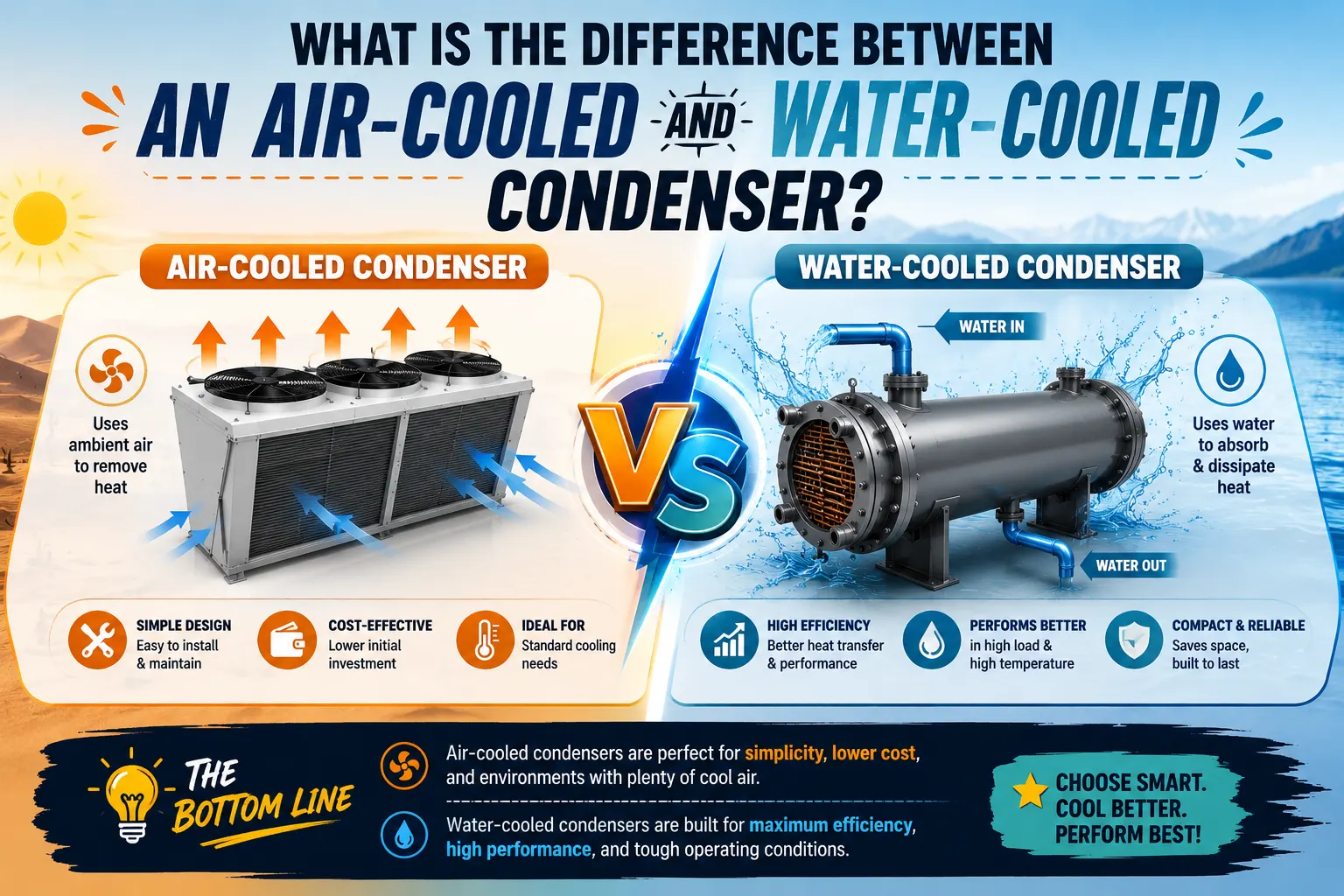
An air cooled system is one of the most widely used cooling technologies across industrial and commercial facilities — and for good reason. But whether it’s the right choice for your specific application is a different question entirely.
Most businesses don’t ask that question until something goes wrong. A compressor runs hot. Energy costs climb. Maintenance becomes a recurring headache rather than a routine task.
Nine times out of ten, it traces back to the same root cause — the wrong cooling technology was specified from day one.
Understanding the real difference between air cooled and water cooled systems, where each one wins, and what ownership actually costs over time is what prevents that mistake. That’s exactly what this guide covers.
The Core Difference — In Plain Terms
Both systems do the same job: remove heat from equipment or a process and reject it somewhere else.
The difference is how they do it.
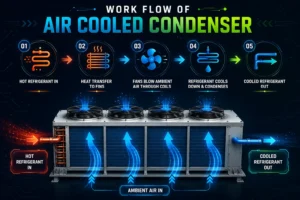
Air cooled system use fans to push ambient air across a condenser or heat exchanger, releasing heat directly into the atmosphere. No water. No cooling tower. No complex pipework.
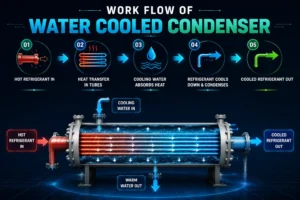
Water-cooled systems circulate water through heat exchangers to absorb heat, then transfer it to a cooling tower where it’s rejected. The cooled water loops back through the system and the cycle repeats.
Simple concept. But the implications for installation cost, maintenance, energy consumption, and long-term reliability are significant — and they differ substantially depending on your application.
What Is an Air Cooled System?
An air cooled system is exactly what it sounds like. Fans draw ambient air across finned coils or heat exchanger surfaces, pulling heat away from the refrigerant or process fluid and releasing it into the surrounding air.
No water supply needed. No cooling tower. No chemical treatment programme.
That simplicity is precisely why air-cooled technology has become the default choice across so many industries.
Where it’s commonly used:
- HVAC and commercial air conditioning
- Industrial and commercial refrigeration
- Manufacturing facility cooling
- Power generation equipment
- Automotive and transport cooling systems
- Packaged process chillers
Why facilities choose it:
- Installs faster with less civil and mechanical work
- Operates without any water supply or treatment
- Lower risk of corrosion, scale, and biological growth
- Easier and cheaper to maintain over time
- Performs reliably across a wide range of climates
As a trusted Cooling System manufacturer in India, NBR Cooling Systems designs air cooled solutions for exactly these applications — built for Indian operating conditions where ambient temperatures, dust levels, and maintenance accessibility all matter.
What Is a Water-Cooled System?
A water-cooled system adds a fluid loop into the heat rejection process. Water absorbs heat from the refrigerant or process through a heat exchanger, carries it to a cooling tower, and releases it through evaporation. The cooled water then returns to the system.
This closed-loop approach allows water-cooled systems to handle significantly larger thermal loads than an equivalently sized air-cooled unit — which is why they’re found in facilities where cooling demand is both heavy and continuous.
Where it’s commonly used:
- Chemical and petrochemical processing plants
- Data centres and large server facilities
- Food and beverage manufacturing
- Pharmaceutical production
- Large commercial complexes and district cooling
- Heavy industrial manufacturing
Why facilities choose it:
- Handles very high continuous cooling loads
- Generally quieter in operation than equivalent air-cooled units
- Can achieve high efficiency under sustained heavy-duty conditions
- Better suited to indoor installation where outdoor airflow is unavailable
The trade-off is infrastructure. Water-cooled systems require cooling towers, water treatment, pumps, pipework, and regular water quality monitoring — all of which add to both capital expenditure and ongoing operating costs.
Side-by-Side Comparison
| Factor | Air Cooled System | Water Cooled System |
| Heat rejection medium | Ambient air | Circulating water |
| Installation complexity | Simple and fast | Complex — requires tower, pumps, pipework |
| Water requirement | None | Continuous supply required |
| Initial capital cost | Lower | Higher |
| Ongoing maintenance | Minimal | Regular — water treatment, tower cleaning |
| Operating cost | Lower overall | Higher due to pumping and treatment |
| Energy efficiency | Excellent for small to medium loads | Better for large, continuous loads |
| Space needed | Requires outdoor airflow clearance | Requires cooling tower and plant room |
| Corrosion and scaling risk | Very low | Requires active water treatment |
| Environmental impact | Zero water consumption | Significant water consumption |
| Best suited for | Commercial, HVAC, mid-scale industrial | Large-scale manufacturing and process industry |
Where Air Cooled Systems Win
For the majority of commercial and mid-scale industrial applications, air cooled system technology wins on almost every practical metric.
Lower upfront cost — No cooling tower, no pump sets, no chemical dosing systems. Installation is faster and the civil work required is far less extensive.
Minimal maintenance — Routine servicing covers fan inspection, condenser fin cleaning, airflow checks, and general system health. That’s it. No water quality testing, no biocide treatment, no scale inhibitor programmes.
No water dependency — In regions where water supply is constrained, expensive, or subject to restriction — which covers a significant portion of industrial India — removing water from the equation entirely is a genuine operational advantage.
Lower corrosion risk — Water systems require active treatment to prevent scale, corrosion, and biological growth including Legionella. Air cooled systems carry none of those risks.
Reliability in diverse climates — Modern air-cooled designs perform consistently across a wide ambient temperature range, making them well suited to the variable climate conditions found across different Indian regions.
Where Water-Cooled Systems Win
Water-cooled systems aren’t the wrong answer — they’re just the right answer for a narrower set of applications.
Very high cooling loads — When a facility needs to reject enormous amounts of heat continuously — a large data centre, a chemical plant, a pharmaceutical manufacturing line — water-cooled systems can handle loads that would require an impractically large air-cooled installation.
Indoor installations — Where there’s no suitable outdoor space for airflow, water-cooled systems allow heat to be rejected remotely via a cooling tower located elsewhere on site.
Continuous heavy-duty operation — Under sustained full-load conditions, well-maintained water-cooled systems can achieve high efficiency. The caveat is that achieving this requires consistent maintenance of the water circuit — which adds cost and complexity.
The honest assessment: water-cooled systems perform best when the application genuinely demands them. For anything below very large continuous loads, the additional infrastructure, water costs, and maintenance overhead often outweigh the performance advantage.
The Maintenance Reality
This is where the choice often becomes clear in practice.
Air-cooled maintenance checklist:
- Clean condenser fins periodically
- Inspect and service fans
- Check airflow clearances around the unit
- Monitor system pressures and temperatures
- Verify refrigerant charge
That’s a manageable, predictable maintenance programme that most engineering teams can handle in-house.
Water-cooled maintenance checklist:
- Monitor and treat water chemistry continuously
- Clean cooling tower fill and basin regularly
- Maintain pumps and pipework
- Conduct Legionella risk assessments
- Control scale and corrosion with chemical dosing
- Inspect and service heat exchangers
Each of those items carries a cost — in labour, chemicals, specialist contractors, and downtime. Over a five or ten year operational period, that difference in maintenance burden adds up to a significant figure.
How to Make the Right Decision for Your Facility
Run through these questions before committing to either technology:
What is your peak cooling load? If it’s modest to medium, air cooled system handles it comfortably. If it’s very large and continuous, water-cooled becomes worth the added complexity.
Is water readily and reliably available on site? If supply is limited, expensive, or subject to restrictions, eliminating water from the equation is a significant advantage.
How much maintenance capacity does your team have? Air cooled systems place less demand on internal engineering resources. Water-cooled systems require more specialist ongoing attention.
Is outdoor space available for the unit? Ai -cooled condensers need airflow clearance. If outdoor installation isn’t feasible, water-cooled with a remote tower may be the only option.
What does the total cost of ownership look like over ten years? Lower capital cost doesn’t always mean lower lifetime cost — but for most mid-scale applications, air-cooled systems deliver a better long-term financial outcome when all costs are factored in.
Quick Decision Guide
Choose air cooled System if your facility:
- Has moderate to medium cooling requirements
- Operates in a location with limited or expensive water supply
- Wants minimal maintenance and operating complexity
- Needs faster installation with lower upfront capital cost
- Values reliability without specialist water treatment expertise
Choose water-cooled if your facility:
- Has very high, sustained cooling demands
- Has reliable water supply and water treatment capability
- Operates continuously at or near full load
- Has indoor space constraints that prevent outdoor air-cooled installation
- Has the engineering resource to manage a more complex maintenance programme
Why NBR Cooling Systems
NBR Cooling Systems is recognised among the leading Cooling System manufacturers in India, delivering thermal management solutions across HVAC, refrigeration, automotive, and industrial process cooling applications.
As an experienced Air Cooled Condenser manufacturer, NBR combines precision engineering with rigorous quality standards — designing products for the actual operating conditions they’ll face, not just laboratory benchmarks.
The product range covers air-cooled condensers, shell and tube heat exchangers, plate heat exchangers, oil coolers, and customised thermal solutions — each selected and specified to match the application requirements of the customer, not a standard catalogue answer.
The Bottom Line
Air cooled System and water cooled systems both work. The question is which one works best for your specific application, your operating environment, and your long-term maintenance capability.
For most commercial buildings, HVAC installations, industrial refrigeration systems, and mid-scale manufacturing facilities — air cooled systems technology delivers better value, simpler operation, and lower total cost of ownership.
For facilities with very high continuous cooling loads, available water infrastructure, and the engineering capacity to manage it — water cooled systems deliver the performance those applications demand.
Get the choice right once, and the equipment serves you reliably for years. Get it wrong, and you spend those same years managing costs and performance issues that a better specification would have prevented.
NBR Cooling Systems helps facilities across India get that specification right — from initial selection through to installation support and long-term technical assistance.
FAQ’s
What is a cooling system and how does it work?
A cooling system is a thermal management system designed to remove excess heat from equipment, machinery, or industrial processes to maintain safe and efficient operating temperatures. It works by absorbing heat and transferring it to a cooling medium, such as air or water, before releasing it into the surrounding environment
How do I know if my cooling system is oversized or undersized?
You can tell if your cooling system is oversized if it cools too quickly, frequently turns on and off (short cycling), and consumes more energy than necessary. An undersized cooling system typically runs continuously, struggles to maintain the desired temperature, and experiences increased wear due to constant operation. A professional load calculation is the most accurate way to determine the correct system size for your application.
How often should HVAC systems be serviced?
HVAC systems should be serviced at least twice a year—once before the cooling season and once before the heating season. Regular maintenance helps improve energy efficiency, prevent unexpected breakdowns, extend equipment lifespan, and ensure the system operates at peak performance.
Can poor maintenance damage a cooling system?
Yes. Poor maintenance can damage a cooling system by causing reduced efficiency, overheating, refrigerant leaks, clogged components, and increased wear on critical parts. Regular servicing helps prevent costly repairs, improves performance, and extends the system’s lifespan.
How can cooling systems reduce energy consumption?
Cooling systems reduce energy consumption by efficiently removing excess heat and maintaining optimal operating temperatures. Proper system sizing, regular maintenance, and energy-efficient components help minimize power usage, improve equipment performance, and lower overall operating costs.
Can upgrading the cooling system reduce operating costs?
Yes. Upgrading to a modern, energy-efficient cooling system can reduce operating costs by lowering energy consumption, improving cooling performance, minimizing maintenance requirements, and extending the lifespan of equipment.
Can a dirty air filter really stop a cooling system from working?
Yes. A dirty air filter can restrict airflow, causing the cooling system to work harder, reduce cooling efficiency, and even lead to overheating or system shutdown in severe cases. Regular filter replacement helps maintain optimal performance and prevent costly repairs.