Air Cooled Condenser Repair or Replacement: When Is a New Coil Worth It?
Posted on November 20, 2026
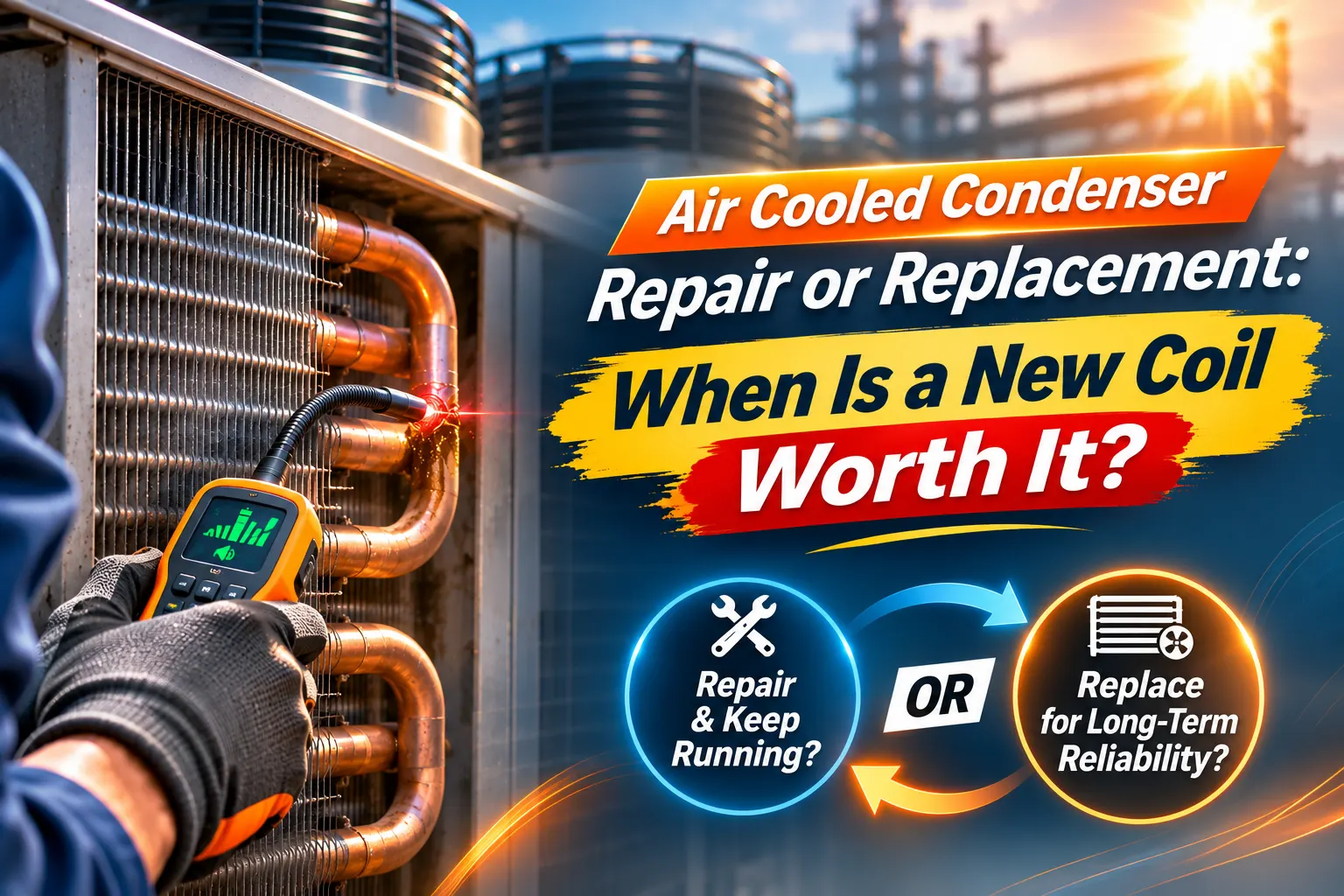
Your air cooled condenser has developed another leak. The maintenance team has fixed it twice, cooling performance still isn’t where it should be, and now someone is suggesting a complete coil replacement.
Do you spend money repairing it again, or is it time to stop patching the problem?
It’s a decision that industrial maintenance teams, HVAC contractors, and plant operators face more often than they’d like. A new condenser coil isn’t a small investment, especially when the system supports cold storage, food processing, or equipment that runs continuously.
But here’s what often gets overlooked: the cheapest repair today isn’t always the cheapest decision over the next twelve months.
A repair might get the system running again. Whether it keeps running efficiently is a different question.
So before approving another repair or ordering a replacement, let’s look at what actually determines whether an Air Cooled Condenser coil is worth saving.
First, Is the Condenser Coil Actually the Problem?
Here’s a mistake that’s easier to make than you might think.
A refrigeration system starts losing cooling capacity. The discharge pressure climbs, the compressor runs longer, and the condenser becomes the first suspect.
But that doesn’t automatically mean the coil has failed.
An air cooled condenser rejects heat by moving ambient air across refrigerant-carrying tubes and fins. When that heat-transfer process is interrupted, the entire refrigeration system can struggle.
Sometimes the problem is a damaged coil. Other times, it’s something that doesn’t require coil replacement at all.
Before blaming the condenser core, check these conditions:
- Dirty or blocked fins: Dust, grease, and industrial debris restrict heat transfer and airflow.
- Fan or motor problems: A damaged fan blade, failing motor, or incorrect fan operation can reduce airflow across an otherwise healthy coil.
- Hot air recirculation: Poor installation clearance can cause discharged hot air to enter the condenser again.
- Refrigerant system problems: Incorrect charge, non-condensable gases, restrictions, or other faults can affect system pressures.
- Damaged connections: A leak at a service connection or accessible joint doesn’t necessarily mean the entire coil must be replaced.
A condenser that performs poorly isn’t automatically a condenser that needs replacing.
The first step is identifying the root cause, not ordering a new component.
5 Signs Your Air Cooled Condenser Coil Needs Replacement
1. Refrigerant Leaks Keep Coming Back
A single leak at an accessible connection may be repairable, but repeated leaks across different sections of the coil can indicate corrosion, tube deterioration, or vibration-related damage. Repairing one spot won’t necessarily prevent another leak from developing. If you’re fixing leaks more often than maintaining the condenser, it’s time to evaluate replacement.
2. Corrosion Is Spreading Across the Coil
Industrial condensers often operate in environments exposed to moisture, dust, chemicals, or salt-laden air. Over time, these conditions can damage fins and refrigerant tubes. While minor surface corrosion may be manageable, extensive pitting, weakened tubing, and multiple corrosion-related leaks can make replacement the more reliable option.
3. Cooling Performance Doesn’t Improve After Maintenance
If the condenser has been cleaned, fans are working correctly, and airflow restrictions have been addressed, but cooling performance remains poor, further investigation is necessary. Damaged fins, restricted internal passages, or deteriorated coil sections may be affecting heat transfer. Before replacing the coil, technicians should confirm that the problem isn’t caused by refrigerant charge, compressor performance, or other system conditions.
4. Repair Costs Are Becoming a Regular Expense
One repair may seem affordable, but repeated servicing, refrigerant handling, labor, and downtime can quickly increase operating expenses. For example, if a condenser needs frequent repairs and each breakdown interrupts production or cold storage operations, replacement may offer better long-term value. Instead of comparing only repair and replacement prices, consider the total cost of keeping the existing condenser operational.
5. The Existing Coil No Longer Meets Cooling Requirements
Sometimes the condenser isn’t severely damaged; it’s simply no longer suitable for the system. Increased cooling loads, equipment upgrades, or higher operating temperatures can make an existing condenser undersized. In such situations, repeated repairs won’t solve the capacity problem. A properly sized replacement may be necessary to meet the updated heat-rejection requirements.
Repair or Replace? Here’s How to Decide
| Condenser condition | Recommended action |
| Dirty fins or restricted airflow | Clean and maintain |
| Faulty fan or motor | Repair the affected component |
| Single accessible, repairable leak | Evaluate professional repair |
| Multiple recurring coil leaks | Consider replacement |
| Extensive corrosion or tube damage | Assess replacement |
| Inadequate cooling capacity | Reassess condenser sizing |
| Frequent breakdowns and high downtime costs | Compare lifecycle costs |
A repair makes sense when the damage is limited and the condenser can continue operating reliably. Replacement becomes more attractive when repeated failures, extensive damage, or insufficient capacity affect long-term performance.
The Hidden Cost of Keeping an Unreliable Condenser
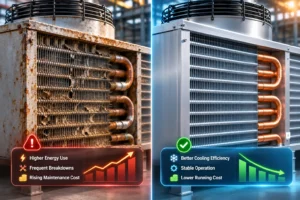
What if repairing your condenser is actually costing you more than replacing it? Most repair quotations only include labor, spare parts, and materials, but the real expenses often go unnoticed. For cold storage facilities, an unexpected condenser failure can put temperature-sensitive inventory at risk, while food processing plants may face production delays and industrial cooling systems can experience costly operational interruptions.
Let’s say your Air Cooled Condenser needs ₹35,000 in repairs, while a complete coil replacement costs ₹1,20,000, including installation. Repairing it seems like the obvious choice, right? But what if the same condenser has already failed twice, and another breakdown could shut down operations for hours? Suddenly, that ₹35,000 repair doesn’t look so affordable.
The real cost isn’t just what you spend fixing the condenser; it’s what you could lose when it fails again. Repeated repairs, refrigerant losses, increased energy consumption, and unexpected downtime can add up over time. Before choosing another repair, compare the expected future maintenance and operating costs with the investment in a reliable replacement.
The question isn’t “How much will this repair cost?” It’s “How much longer can we afford to keep repairing it?”
What Should You Check Before Buying a New Condenser Coil?
Replacing an industrial condenser isn’t simply about finding another coil with the same dimensions. The new unit must match the system’s operating conditions and heat-rejection requirements.
Before contacting an Air Cooled Condenser Manufacturer, confirm the required heat-rejection capacity, refrigerant type, ambient design temperature, airflow requirements, coil construction, operating pressures, and installation dimensions.
For example, a condenser designed for moderate ambient temperatures may struggle in an industrial facility experiencing extreme summer heat. Similarly, choosing the wrong coil configuration can result in poor airflow, increased condensing pressure, and reduced system efficiency.
The goal isn’t just to replace a damaged coil. It’s to prevent the same performance issues from happening again.
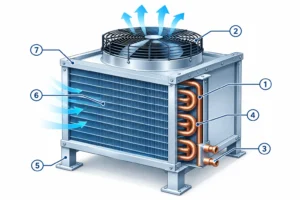
Before Ordering a New Coil, Check These 7 Specifications
Once replacement is justified, the next challenge is choosing the correct condenser.
Replacing a failed coil with another coil of similar dimensions isn’t enough.
A properly selected replacement needs to match the system’s refrigerant, operating conditions, and heat-rejection requirements.
Here’s what to confirm with your Air Cooled Condenser Manufacturer.
1. Actual Heat Rejection Requirement
The condenser must reject the heat absorbed by the refrigeration system plus the relevant heat added during compression and any additional loads specified by the system design.
Cooling capacity and condenser heat-rejection capacity are not interchangeable numbers.
2. Refrigerant Type
The replacement must be compatible with the specified refrigerant, operating pressures, and applicable safety requirements.
Don’t assume a coil designed for one refrigerant is suitable for another without engineering verification.
3. Design Ambient Temperature
A condenser that works well at 30°C ambient conditions may not deliver the same capacity when outdoor temperatures reach 43°C.
The replacement should be evaluated at the site’s actual design conditions, not just a convenient catalogue rating.
4. Airflow and Installation Space
The coil and fan arrangement must work together.
Check available airflow, fan performance, discharge direction, and clearance around the equipment.
Even a correctly sized coil can underperform if its installation allows hot air recirculation.
5. Coil Construction and Material
Fin-and-tube and microchannel coils have different construction, installation, serviceability, and performance characteristics.
The correct selection depends on the application rather than one design being universally better.
6. Connection Details and Physical Dimensions
Confirm header arrangement, refrigerant connections, mounting points, coil depth, and the space available for installation.
Poor physical compatibility can increase installation costs and cause avoidable delays.
7. Corrosion Exposure and Testing Requirements
If the previous coil suffered corrosion damage, selecting another condenser without addressing the operating environment can lead to the same problem again.
Discuss material selection, protective treatments where appropriate, pressure testing, and quality checks with the manufacturer.
A replacement should solve the reason the old condenser failed, not simply fit where it used to sit.
Why Choosing the Right Manufacturer Matters
An unsuitable replacement can create new problems even when the original condenser issue has been resolved. That’s why working with an experienced Industrial Air Cooled Condenser Manufacturer matters, particularly for applications involving continuous operation, refrigeration equipment, chillers, and industrial cooling systems.
At NBR Cooling Systems, condenser solutions are manufactured for applications including HVAC, refrigeration, automotive cooling, and industrial equipment. Selecting the appropriate condenser design requires understanding operating conditions, coil construction, airflow, and cooling requirements.
Whether replacing an existing condenser or upgrading cooling equipment, reviewing these specifications with the manufacturer can help avoid compatibility issues and unnecessary expenses.
the Problem, Not Just the Symptom
An air cooled condenser doesn’t need replacement every time cooling performance drops.
A blocked coil, faulty fan, or leaking connection may be repairable without replacing the core.
But repeated refrigerant leaks, widespread corrosion, physically damaged tubes, or an unsuitable condenser design can change the decision.
Before spending money either way, establish three things:
- What exactly has failed? Confirm whether the issue is in the coil, airflow system, refrigerant circuit, or another component.
- Will repairing it restore dependable performance? Consider the severity of damage and the likelihood of another failure.
- Does replacement offer better value over the equipment’s remaining operating life? Include downtime, maintenance, energy use, and installation costs.
Sometimes repairing an existing condenser is the smarter investment.
Other times, the bigger expense is continuing to repair a coil that can no longer deliver reliable service.
The right decision starts with proper diagnosis and ends with a condenser that genuinely matches the system’s needs.
FAQs
- Can an air cooled condenser coil be repaired instead of replaced?
Yes. Some localized leaks, damaged connections, and accessible defects can be repaired by qualified technicians, depending on the coil’s material and construction. Extensive corrosion, multiple leaks, and certain microchannel core failures may make replacement more appropriate. - How do I know if my air cooled condenser coil is failing?
Warning signs can include recurring refrigerant leaks, visible corrosion, damaged tubing, and persistent performance problems. However, high pressure and poor cooling can also result from airflow restrictions, refrigerant issues, or other system faults. Proper diagnosis is necessary before declaring the coil defective. - Is replacing a condenser coil cheaper than repeated repairs?
It depends on the cost and reliability of the repair, remaining coil condition, equipment downtime, and replacement price. A lifecycle-cost comparison is more useful than considering only the immediate repair quotation.
- Can a damaged microchannel condenser be repaired?
Some external connections or specific defects may have manufacturer-approved repair procedures. Damage to thin microchannel passages can be difficult to repair reliably, so core replacement is often considered. The correct decision depends on the particular coil and manufacturer guidance. - Does a new condenser coil automatically improve cooling efficiency?
Not necessarily. A suitable replacement can restore performance lost to physical coil defects or inadequate capacity. However, problems caused by poor airflow, incorrect refrigerant conditions, or other system components must also be corrected. - What should I ask an air cooled condenser manufacturer before buying a replacement?
Provide the refrigerant type, required heat-rejection capacity, design ambient temperature, operating conditions, physical dimensions, connection details, and installation requirements. Ask how the proposed replacement has been selected and tested for the intended application. - Should I replace the entire condenser unit or just the coil?
That depends on whether the fans, motor assemblies, casing, electrical components, and other parts remain serviceable and compatible with the new coil. Replacing only the defective core may be practical when the remaining equipment is in good condition. - How do I choose an industrial air cooled condenser manufacturer?
Look for application-specific engineering support, suitable materials, compatible refrigerant designs, documented testing, and the ability to match the equipment to your actual operating requirements. These factors matter more than choosing a condenser on price or dimensions