
Heat Exchanger Materials: Stainless Steel vs Copper vs Titanium, Which One Should You Pick?
Posted on November 17, 2026
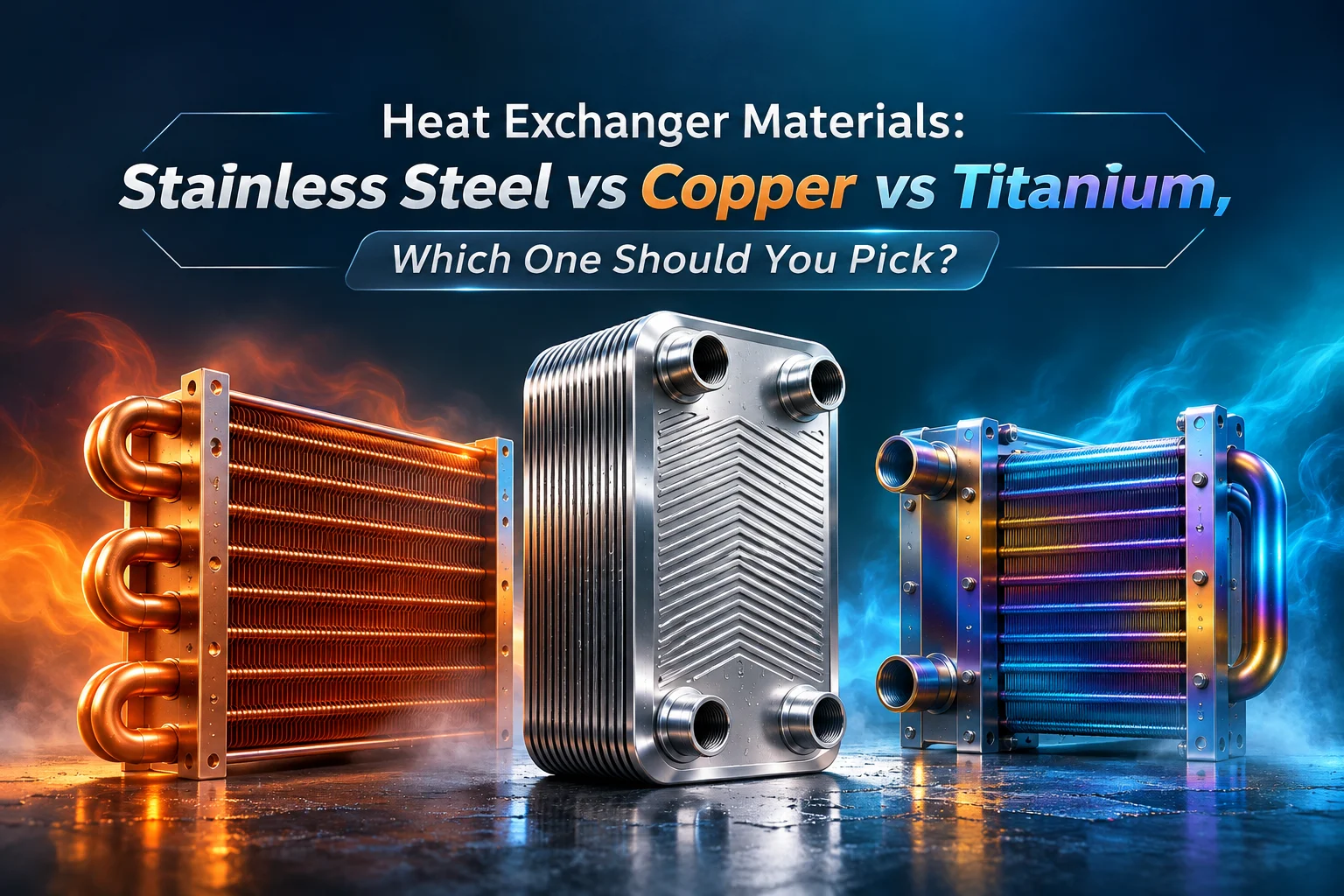
Ask a plant engineer in Dahej, a dairy owner in Pune and a shipyard supervisor in Kochi which metal makes the best heat exchanger, and you’ll get three confident, completely different answers. Strangely, all three can be right. The metal inside your heat exchanger decides how fast it moves heat, how long it survives your fluid, and how much you’ll spend over the next fifteen years. Pick wrong and you’re re-tubing before the warranty ink dries. So let’s sort it out, no jargon, no brochure talk.
The Short Answer:
Copper moves heat best. Stainless steel is the tough, hygienic all-rounder. Titanium is the corrosion-proof specialist for seawater and aggressive chemicals, at a premium price. No metal wins everywhere. Your fluid, operating temperature and budget decide the winner.
Why Material Matters More Than Size
Most buyers ask about capacity first. Engineers ask three different questions: how well does the metal conduct heat, how does it behave with the fluid running through it, and how long will it last? A heat exchanger that cools beautifully on day one but pits, cracks or fouls by year three is just an expensive lesson. Material is the quiet decision that sets efficiency, lifespan and maintenance cost.
Copper: The Heat-Moving Champion
Copper’s thermal conductivity is roughly 400 W/m·K, around twenty times that of stainless steel. That’s why it has ruled HVAC coils, refrigeration and traditional radiators for decades. It’s also easy to form and braze, and it naturally resists biofouling, the slimy growth that clogs many water-cooled systems.
The catch? Copper doesn’t love every fluid. Ammonia, sulphur compounds and very fast flow can eat into it through corrosion and erosion. It’s also softer than steel, and its price swings with the metal market.
Best for: HVAC and refrigeration, clean-water cooling, oil coolers and copper-brass radiators.
Stainless Steel: The Tough All-Rounder
Stainless conducts heat poorly (roughly 15–16 W/m·K), but it’s strong enough to be made with thin walls, which closes much of the gap. It’s also hygienic and easy to clean, which is why food, dairy, beverage and pharma plants rely on it. Grade 304 handles general duty, while 316 adds molybdenum for better resistance to chlorides.
Its weak spot is salt. In warm, chloride-rich water, even stainless can suffer pitting and stress corrosion cracking. It’s also heavy, with a density of about 8 g/cm³.
Best for: food and beverage, pharma, chemical processing and general industrial duty with clean or mildly corrosive fluids.
Titanium: The Corrosion-Proof Specialist
Titanium forms a tough, self-healing oxide film that makes it close to immune to seawater and many chlorides. It’s also about 45% lighter than steel (4.5 g/cm³ versus roughly 8), and strong enough to run in very thin sections. Its conductivity is low (around 17–22 W/m·K), but thin walls help offset that.
The trade-off is price. Titanium costs several times more than stainless, and fabricating it needs real skill and controlled welding conditions. It earns its place where a cheaper metal would be replaced in a few years anyway.
Best for: seawater cooling, offshore and marine systems, desalination, and aggressive chemical or chlorinated service.
Stainless Steel vs Copper vs Titanium at a Glance
| Factor | Copper | Stainless Steel | Titanium |
| Thermal conductivity | Highest (about 400 W/m·K) | Low (about 15–16 W/m·K) | Low (about 17–22 W/m·K) |
| Weight | Heavy (about 9 g/cm³) | Heavy (about 8 g/cm³) | Light (about 4.5 g/cm³) |
| Upfront cost | Moderate, price-volatile | Moderate | Highest |
| Seawater and chlorides | Fair, alloys perform better | Grade-dependent, risk of pitting | Excellent |
| Strength | Soft | Strong | Very strong for its weight |
| Fabrication | Easy | Straightforward | Specialised |
| Best for | HVAC, refrigeration, radiators | Hygienic and general process duty | Marine and aggressive chemicals |
Conductivity Isn’t the Whole Story
Here’s the part spec sheets skip. A heat exchanger’s real performance depends on wall thickness, fluid flow, surface area and, most importantly, fouling. Scale, sludge and biofilm often resist heat flow more than the metal itself. A thin titanium plate that stays clean can outperform a thick copper tube that clogs. So judge the whole design running on your actual fluid, not just the number on the metal’s datasheet.
Which Metal for Which Job?
- Clean water, refrigerant or oil, where heat transfer matters most: copper.
- Hygiene-critical or general industrial duty: stainless steel, with 316 if chlorides are present.
- Seawater, brine or chlorinated fluids where failure is expensive: titanium.
- Vehicles, engines and compact AC where weight and cost count: aluminium, covered next.
The Fourth Contender: Aluminium and Microchannel Designs
If your heat exchanger lives on a truck, bus, generator or air conditioner, there’s a fourth metal worth knowing. Aluminium is light (about 2.7 g/cm³), conducts heat well (roughly 200+ W/m·K) and, when brazed into a compact core, delivers excellent performance per kilogram. All-aluminium builds also avoid the copper-to-aluminium joints that can corrode in humid or salty air.
This is why more OEMs now shortlist micro channel heat exchanger manufacturers in India when weight, size and refrigerant charge matter. Microchannel designs use flat multi-port tubes and louvered fins to pack a lot of surface area into a small, light coil.
Material Is Only Half the Job: Build Quality
Two heat exchangers in the same metal can perform completely differently. What separates one that lasts from one that leaks is the joining process, the leak testing and the design behind the core. Before you sign off, ask your supplier how every unit is brazed, how it’s pressure and leak tested, what corrosion protection is available, and whether the core can be customised to your airflow, pressure and space.
That’s why it pays to buy from an experienced heat exchanger manufacturer in India who will ask about your fluid, temperature and duty cycle before quoting, rather than just matching a catalogue size.
NBR’s Take: Match the Metal to the Mission
This is the thinking behind how nbrcoolingsystem approaches every cooling product it builds. With over 40 years of experience, IATF 16949 and ISO 9001:2015 certifications, in-house controlled-atmosphere brazing furnaces, and testing that includes helium leak, salt-spray and vibration checks, NBR designs aluminium radiators, condensers, charge air coolers and oil coolers, plus copper-brass radiators and bar and plate heat exchangers, for automotive, commercial vehicle, off-highway and industrial duty. Its microchannel condenser range targets the weight-and-efficiency end of the market. (Exact specifications and material options should always be confirmed for your own application.) And a good partner will tell you honestly when your duty calls for a different metal altogether.
The Bottom Line
There’s no single best material, only the right one for your fluid, temperature and budget. Copper wins on raw heat transfer, stainless steel on hygiene and everyday toughness, and titanium on surviving seawater and harsh chemistry when failure is not an option. Aluminium and microchannel designs quietly take the prize where weight, compactness and cost matter most. Choose by the real operating conditions, not by reputation, and back the metal with proven build quality and testing. Do that, and your heat exchanger will keep working long after the purchase order is forgotten.
FAQs
Which material is best for a heat exchanger?
There’s no universal winner. Copper transfers heat best, stainless steel offers strength and hygiene, and titanium resists seawater and aggressive chemicals. Your fluid, temperature and budget decide.
Is copper better than stainless steel for heat transfer?
Yes. Copper conducts heat roughly twenty times better than stainless steel. But stainless can be made thinner and is far more resistant to many corrosive fluids, so it often wins in real-world process duty.
Why is titanium used in seawater heat exchangers?
Titanium forms a protective oxide layer that resists chloride corrosion, so it lasts in seawater where stainless steel and copper can pit or erode. The higher upfront cost is often justified by the long life.
Is titanium better than stainless steel?
It’s better for seawater and chloride-heavy service, and it’s much lighter. For clean, non-corrosive duty, stainless steel is usually the more economical choice.
Can stainless steel handle seawater?
Only some grades, and with limits. Grade 316 resists chlorides better than 304, but warm, salty water can still cause pitting and stress corrosion cracking, so check the grade and operating temperature.
Why is copper not used in every heat exchanger?
Copper can corrode in the presence of ammonia and sulphur compounds, can erode at high flow velocities, is heavy, and its price fluctuates. In many applications, aluminium or stainless steel is the better fit.
Are aluminium heat exchangers as good as copper ones?
In many applications, yes. Aluminium conducts less heat per unit, but well-designed brazed and microchannel cores add surface area and match real-world copper performance at lower weight and cost.
How do I choose the right heat exchanger manufacturer?
Look at their engineering support, brazing and testing processes, certifications and ability to build to your drawings or duty. Share your fluid, temperature, pressure and space limits so they can recommend the right design.