
Charge Air Cooler vs. Intercooler: Are They Actually the Same Thing?
Posted on October 14, 2026
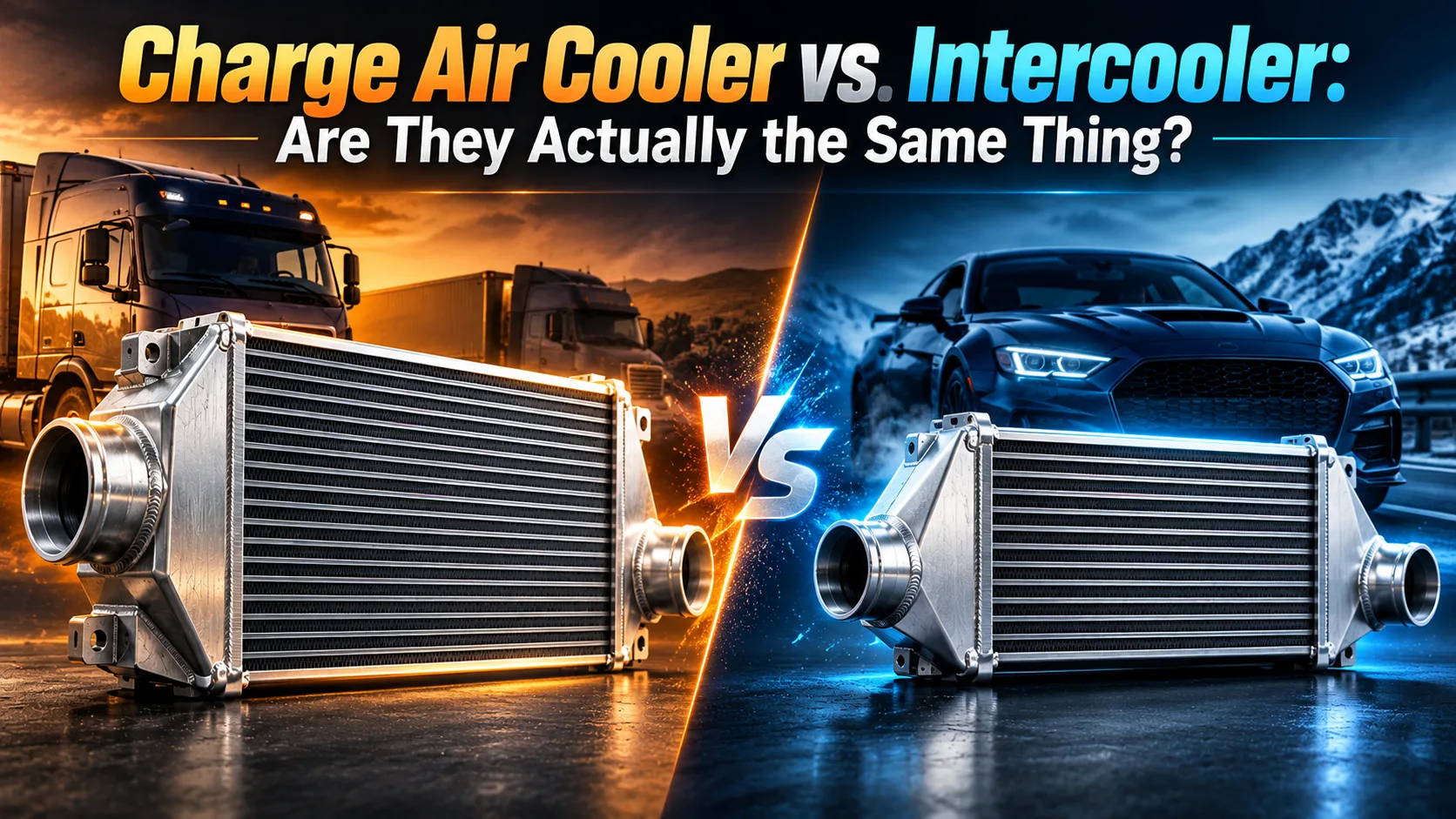
Pull up a truck manual and it says “charge air cooler.” Open a car forum and everyone’s talking about their “intercooler.” Same engine bay, same pipes, same job, so is somebody wrong? Not quite, and not entirely. The confusion is real, and it can leave you ordering the wrong part or misreading a quote. Let’s clear it up, no jargon, no guesswork, just the real story.
The One-Sentence Version
On most turbocharged engines, they’re the same part. The name just depends on who’s talking. “Charge air cooler” is the heavy-duty and OEM term, and “intercooler” is the everyday one. The technical meanings only split when you get into multistage compression.
First, Why Does Air Need Cooling At All?
A turbocharger works by squeezing air before it enters the engine. Squeezing air makes it hot, easily well over 100°C by the time it leaves the turbo. And here’s the catch: hot air is thin air. It carries less oxygen into each cylinder, so you burn less fuel per stroke and get less power from the same engine.
That’s where the cooler comes in. It sits between the turbo and the intake, pulls the heat out, and hands the engine denser, oxygen-rich air. That means better combustion, steadier output, and less thermal stress on everything downstream. It’s why you’ll find one on nearly every turbocharged diesel.
Meet the Charge Air Cooler: The Engine’s Cooling Specialist
A charge air cooler is a heat exchanger built specifically to cool the compressed air going into an engine. The “charge” is simply the air being fed to the cylinders.
You’ll see this name on trucks, buses, tractors, generators, marine engines and construction machinery. When an engineer writes a spec sheet or an OEM sends a drawing, this is almost always the word they use.
Meet the Intercooler: The Name Everyone Knows
“Intercooler” is the name that stuck in car culture. Strictly speaking, it means a cooler placed between two compression stages, which is why you’ll still see the word on multistage air compressors. But on a turbocharged car, people use it for the cooler between the turbo and the engine, which is the exact same job a charge air cooler does.
In simple terms:
- Charge air cooler: the engine-focused name, common in heavy-duty and OEM work.
- Intercooler: the everyday name, technically “between compression stages.”
- Aftercooler: a third cousin that cools air after the final stage, mostly on industrial compressors.
So if both parts sit on the same engine doing the same job, the name is a habit, not a difference.
The Difference That Actually Matters: Air-to-Air or Air-to-Liquid
Here’s where choosing gets real, because both names cover two very different designs.
An air-to-air cooler passes hot charge air through internal tubes while outside air flows across the fins. It’s simple, with no pump and no coolant circuit, which is why you’ll find it on most trucks, buses and tractors. Its weak spots are hot weather, restricted airflow and fins clogged with dirt.
An air-to-liquid cooler hands the heat to a coolant, which carries it to a separate radiator. It’s compact and gives you freedom in where the core sits, plus shorter piping, but it needs extra plumbing and a pump. It’s a strong fit when space is tight.
Neither is “better.” Space, climate and duty cycle decide.
What Really Decides Performance
Most buyers look at size first. Engineers look at two numbers: heat rejection (how much heat comes out) and pressure drop (how much airflow you lose getting through). A cooler that cools brilliantly but chokes the air forces the turbo to work harder, so you’ve gained nothing. Judge both together, at your real airflow.
Material and build matter too. Aluminium is the go-to because it’s light, conducts heat well and suits compact cores. And in heavy-duty use, welds and joints face pressure swings, heat cycles and vibration every single day, so build quality is what separates a cooler that lasts from one that leaks in a year.
When Your Cooler Is Quietly Struggling
A leaking or clogged cooler doesn’t always announce itself. You might notice lost power, odd boost pressure, higher intake temperatures, black smoke, or oil residue around the joints. Before you replace anything, though, remember the same symptoms can come from a turbo fault, a blocked intake or a bad sensor. Inspect and pressure-test first. It saves money.
What This Means When You’re Buying One
Here’s the part most buyers miss: the name on the quote matters far less than whether the cooler was engineered for your engine. Two units labelled “intercooler” can have completely different cores, tank designs and pressure ratings. That’s why a good supplier will ask for your engine model, boost pressure, airflow, mounting dimensions and operating environment before quoting.
It also pays to buy from a proper heat exchanger manufacturer in India that designs around real thermal performance, not one that just matches a catalogue size. A cooler built to squeak past a minimum spec can quietly undermine an otherwise excellent engine.
NBR’s Take: Build It for the Heat, Not the Datasheet
This is the mindset behind how NBR Cooling Systems builds charge air coolers for automotive, commercial vehicle, off-highway and industrial applications. NBR’s published specifications include aluminium core designs, core thicknesses from 12 mm to 150 mm, core sizes up to 2500 mm × 1000 mm, and helium leak, salt-spray and vibration testing. (Exact specifications and test requirements should always be confirmed for your own application.)
NBR also offers OEM manufacturing built to your drawings, which helps when an off-the-shelf part simply won’t fit. And because aluminium cooling systems are now the standard for modern engines, NBR’s aluminium cores are designed around that same light-weight, high-conductivity advantage.
Same Job, Different Names
A charge air cooler and an intercooler are, in almost every real engine, two names for the same part doing the same job: pulling heat out of compressed air so the engine burns cleaner and stronger. The names split only in multistage compression, where “intercooler” and “aftercooler” have their own strict meanings. What genuinely matters is the design (air-to-air or air-to-liquid), the balance of heat rejection and pressure drop, and the build quality behind it. Choose on those, and the label won’t matter. Choosing a cooler from an experienced heat exchanger manufacturer in India isn’t a footnote decision. It’s the difference between an engine that runs strong for years and one that’s quietly struggling from day one.
FAQ’s
Is a charge air cooler the same as an intercooler?
On most turbocharged engines, yes. Both cool compressed intake air before it reaches the cylinders. Technically, “intercooler” means cooling between compression stages, while “charge air cooler” is the engine-specific term.
What’s the difference between an intercooler and an aftercooler?
An intercooler cools air between two compression stages, and an aftercooler cools it after the final stage. The difference mostly matters on multistage industrial compressors.
Which is better: air-to-air or air-to-liquid?
Neither wins everywhere. Air-to-air is simpler and needs less maintenance, and air-to-liquid is more compact and flexible on placement. Your space, climate and duty cycle decide.
Why does pressure drop matter in a charge air cooler?
Pressure drop is the pressure lost as air flows through the cooler. Too much of it reduces the pressure reaching the intake and makes the turbo work harder, so it should always be judged alongside cooling performance.
What are the signs of a faulty charge air cooler?
Common signs are reduced power, boost leaks, higher intake temperatures, black smoke and oil residue near the joints. Since a turbo fault or sensor problem can look similar, inspect and pressure-test before replacing it.
Can I drive with a leaking charge air cooler?
A small leak may still let the engine run, but you’ll lose power and efficiency and put extra strain on the turbo. It’s best to get it checked soon.
How do I clean a charge air cooler?
Start by clearing dirt and debris from the external fins. For oil or contamination inside, follow the manufacturer’s cleaning guidance and pressure-test the cooler afterwards.
How do I choose a charge air cooler manufacturer?
Look at their engineering support, core design range, testing procedures and quality control, and whether they can build to your exact specifications. Giving them accurate engine and installation details helps them recommend the right cooler.