
Counter Flow or Parallel Flow: Which Heat Exchanger Flow Arrangement Is Right for You?
Posted on August 31, 2026
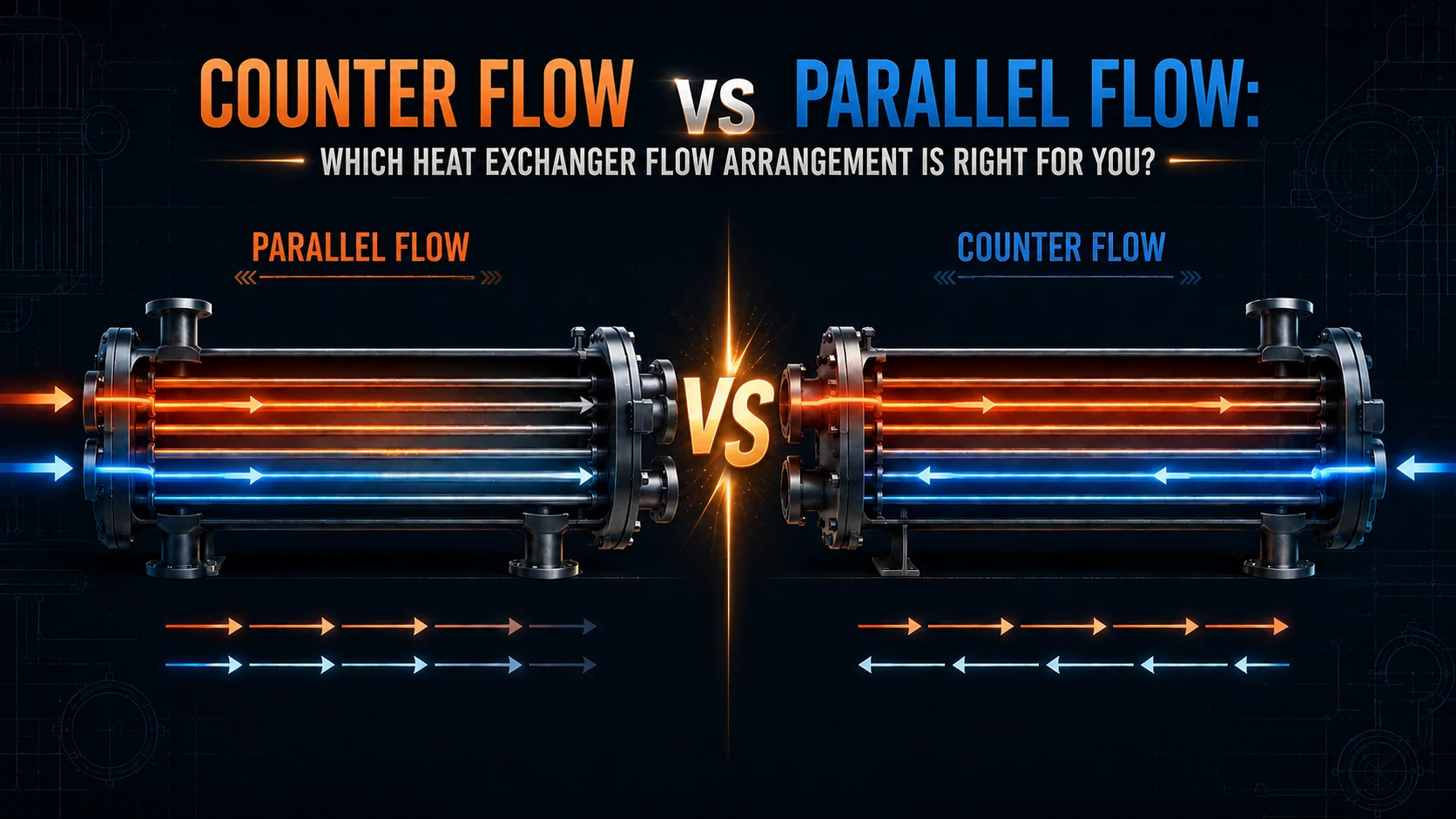
When it comes to thermal systems, the performance of a heat exchanger depends on more than just its size, material, plates, or tubes. One crucial factor is how the two fluids move in relation to each other.
The same heat exchanger can perform very differently depending on whether the fluids move in the same direction or opposite directions. This is where counter flow vs parallel flow heat exchanger arrangements become important.
Choosing the right arrangement can improve efficiency, reduce energy consumption, and help achieve better temperature performance.
Why Does Flow Direction Matter in a Heat Exchanger?
A heat exchanger transfers thermal energy between two fluids — usually one hot and one cold — without allowing them to physically mix.
The fluids are separated by a conductive surface such as tubes, plates, or channels. However, the direction of fluid flow directly affects:
- Heat transfer efficiency
- Temperature difference across the exchanger
- Required heat transfer surface area
- Outlet temperature performance
- Thermal stress on the equipment
The two most common arrangements are parallel flow and counter flow.

Parallel Flow Heat Exchanger: How Does It Work?
In a parallel flow heat exchanger, both fluids enter from the same end and travel in the same direction.
The temperature difference between the fluids is highest at the inlet, resulting in rapid initial heat transfer. However, as both fluids move through the exchanger, the hot fluid cools and the cold fluid warms.
As a result, the temperature difference gradually decreases along the length of the heat exchanger.
Advantages
- Simpler design in many configurations
- More even temperature distribution
- Can help reduce thermal stress
- Rapid heat transfer at the inlet
Limitations
- Lower overall thermal efficiency than counter flow
- Requires more surface area for the same thermal duty
- The cold fluid outlet temperature cannot exceed the hot fluid outlet temperature
Counter Flow Heat Exchanger: Why Is It More Efficient?
In a counter flow heat exchanger, the hot and cold fluids enter from opposite ends and move in opposite directions.
This arrangement maintains a more consistent temperature difference throughout the heat exchanger, allowing heat transfer to remain effective across a greater portion of the unit.
Advantages
- Higher overall heat transfer efficiency
- Less surface area required for the same thermal performance
- More compact equipment design
- Better for close temperature approaches
- The cold fluid outlet temperature can, in some cases, exceed the hot fluid outlet temperature
Limitations
- Temperature distribution can be less uniform
- Localized thermal stress may be higher in certain designs
- Piping arrangements can sometimes be more complex

Counter Flow vs Parallel Flow: Quick Comparison
| Factor | Parallel Flow | Counter Flow |
| Fluid direction | Same direction | Opposite directions |
| Fluid entry points | Same end | Opposite ends |
| Thermal efficiency | Lower | Higher |
| Surface area required | More | Less |
| Temperature difference | Decreases steadily | More consistent |
| Cold outlet temperature | Cannot exceed hot outlet | Can exceed hot outlet |
| Thermal stress | More evenly distributed | Can be more concentrated |
Which Heat Exchanger Flow Arrangement Should You Choose?
The right choice depends on your application.
Choose Counter Flow When:
- Maximum efficiency is the priority
- Space is limited
- A close temperature approach is required
- Higher heat recovery is needed
Choose Parallel Flow When:
- More even temperature distribution is important
- Thermal stress is a major concern
- A simpler system arrangement is preferred
- Rapid initial heat transfer is useful for the application
In many industrial, HVAC, refrigeration, and process cooling applications, counter flow is commonly preferred because of its superior thermal efficiency and compact design potential.
Why the Right Heat Exchanger Manufacturer Matters
Choosing between counter flow and parallel flow is only part of the decision. The actual performance of the unit also depends on its design, materials, manufacturing quality, and suitability for the operating conditions.
Working with an experienced heat exchanger manufacturer in India can help ensure that the flow arrangement and equipment design match your specific application requirements.
For compact and high-efficiency applications such as HVAC, refrigeration, and electric vehicle thermal management, specialized micro channel heat exchanger manufacturers in India may also offer suitable solutions.
When comparing manufacturers, NBR Cooling Systems is one option worth considering for technical capability, material options, and application-focused thermal solutions.
Final Thoughts
The difference between counter flow and parallel flow heat exchangers may appear simple, but flow direction can have a major impact on efficiency, temperature performance, equipment size, and operating costs.
Counter flow generally offers better thermal efficiency and a more compact design, while parallel flow provides a simpler arrangement and more even temperature distribution.
The best choice ultimately depends on your temperature requirements, available space, fluid characteristics, and overall system design.
Choose the right flow direction, and your heat exchanger can deliver better performance for years to come.
FAQ’s
When should I choose parallel flow instead of counter flow?
Choose parallel flow instead of counter flow when a more even temperature distribution and reduced thermal stress are more important than maximum heat transfer efficiency. It can also be suitable for applications where rapid initial heat transfer or a simpler flow arrangement is preferred.
Why is counter flow more efficient than parallel flow?
Because the hot and cold fluids move in opposite directions, the temperature difference between them stays more consistent across the entire length of the exchanger, allowing heat transfer to remain effective throughout — not just concentrated at the inlet like in parallel flow.
Which flow arrangement requires less heat transfer surface area?
Counter flow. Because it sustains a more consistent temperature difference throughout, it can achieve the same thermal duty with a smaller, more compact heat exchanger than a parallel flow design would need.
Is counter flow always used in HVAC and refrigeration systems?
Not always, but it’s commonly preferred in these applications because of its superior thermal efficiency and compact footprint, especially where space and heat recovery performance are both priorities.
Does the manufacturer matter as much as the flow arrangement itself?
Yes, arguably more. Even the right flow arrangement won’t perform as expected without quality materials and construction behind it. A poorly built counter flow unit can underperform a well-engineered parallel flow one — which is why sourcing from an experienced manufacturer like NBR Cooling Systems matters just as much as picking the right arrangement.