
Failed Oil Cooler vs. Blown Head Gasket: How to Tell the Difference
Posted on August 18, 2026
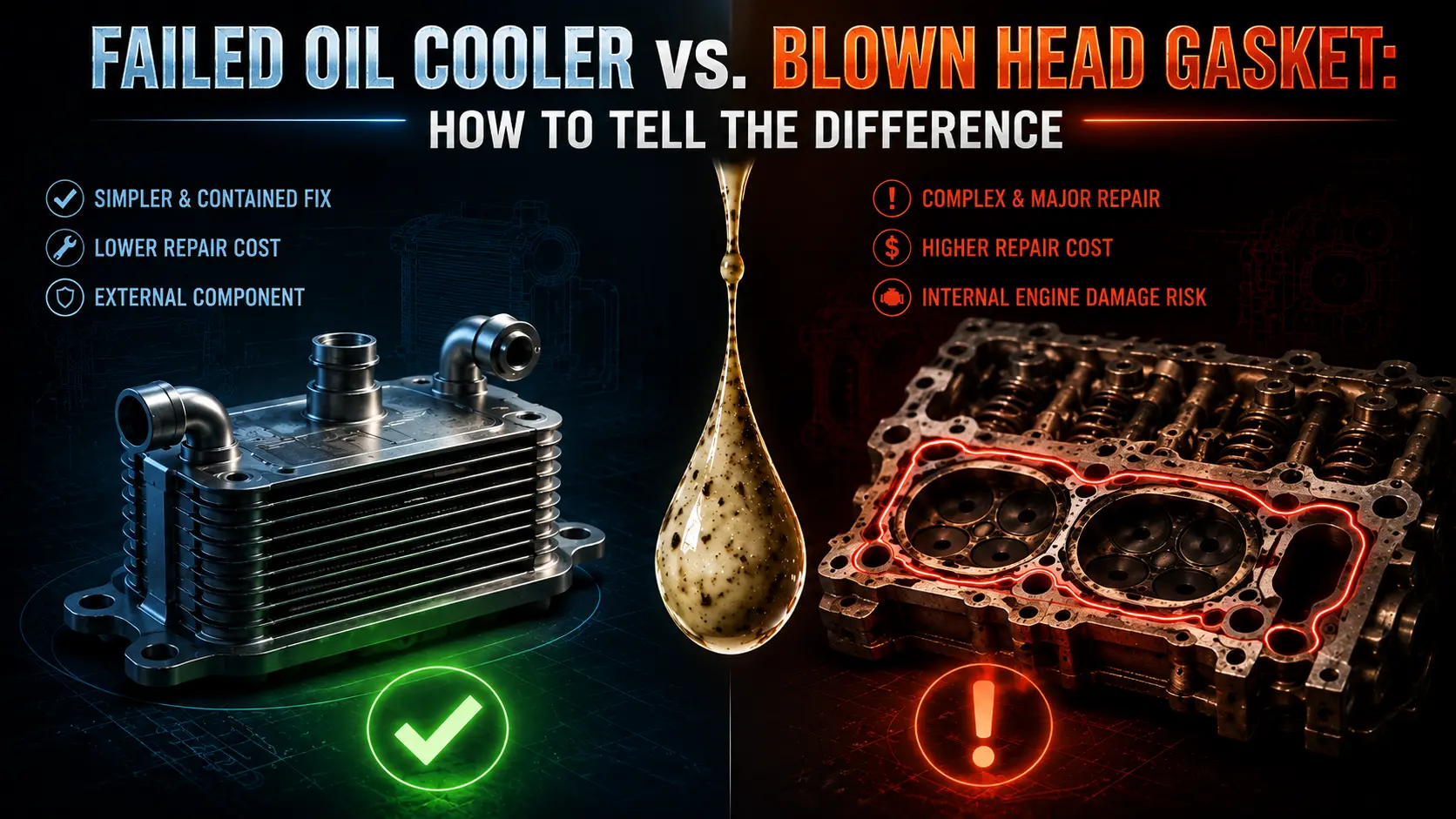
There’s a particular moment that can make any mechanic, fleet manager, or vehicle owner nervous: you open the coolant reservoir and instead of seeing clean coolant, you find a thick, milky, sludge-like mixture.
Oil and coolant have mixed—and that’s never supposed to happen.
At this point, two possibilities immediately come to mind: a failed oil cooler or a blown head gasket. Unfortunately, both problems can create remarkably similar symptoms, but the repairs are very different in terms of complexity, cost, and downtime.
So, how do you tell which one you’re actually dealing with?
Let’s break it down.
Why Do Oil Cooler Failures and Head Gasket Problems Look So Similar?
The confusion starts because both failures create an unwanted pathway for fluids to mix.
An oil cooler is a heat exchanger specifically designed to bring oil and coolant close to each other. They normally remain separated by thin metal walls, seals, or internal passages. If the cooler core or its seals fail, oil and coolant can cross into each other’s circuits.
A head gasket has a much bigger job. It seals the connection between the engine block and cylinder head while keeping separate the passages carrying oil, coolant, and combustion gases.
When the head gasket fails, it can allow:
- Combustion gases to enter the cooling system
- Coolant to enter the engine oil
- Coolant to enter a cylinder
And that’s why the same visible symptom—oil-contaminated coolant—can point to two completely different problems.
The important difference is where the failure is happening.
The Good News: It May Not Be a Head Gasket
Seeing milky coolant can immediately make you think, “This is going to be an expensive engine repair.”
But don’t jump to that conclusion yet.
A failed oil cooler can also cause coolant and oil to mix, while leaving the engine’s actual combustion process largely unaffected.
That means if the engine is otherwise running normally, the oil cooler deserves serious attention before assuming the worst.
The Most Important Clue: What Else Is Happening?
The milky coolant itself isn’t enough to make a reliable diagnosis.
The better question is:
What other symptoms are you seeing?
Signs That Point Toward a Failed Oil Cooler
An oil cooler failure becomes more likely when:
- The milky or contaminated coolant is essentially the only major symptom
- The engine starts easily
- The engine idles smoothly
- Engine power remains normal
- There is no white smoke coming from the exhaust
- There are no noticeable misfires or rough-running issues
- Engine compression remains normal
In simple terms, if the engine is running normally but the coolant looks like an unpleasant oil-and-coolant “milkshake,” the oil cooler is one of the first components worth investigating.
Signs That Point Toward a Blown Head Gasket
A head gasket problem becomes more likely when contamination is accompanied by additional engine symptoms, such as:
- White smoke from the exhaust, indicating coolant may be entering the combustion chamber
- Engine misfires
- Rough running
- Increasing or recurring overheating
- Bubbling or “puking” from the coolant overflow tank or degas bottle
- White residue appearing around the coolant reservoir
- Noticeable loss of compression in one or more cylinders
Here’s a useful rule of thumb:
Milky coolant + otherwise normal engine = investigate the oil cooler.
Milky coolant + white smoke, overheating, misfires, combustion gases, or compression loss = investigate the head gasket.
It isn’t a substitute for proper testing, but it gives you a much better starting point.
How Do You Confirm the Problem?
Symptoms can point you in the right direction, but testing is what confirms the diagnosis.
Replacing a head gasket—or an oil cooler—based purely on guesswork can become an expensive mistake.
Here are some of the practical tests used to narrow it down.
1. Cooling System Pressure Test
A cooling-system pressure test uses a pressure tester with the appropriate reservoir-cap adapter to check whether the cooling system can maintain pressure.
It is one of the most useful ways to investigate internal coolant leaks and, when combined with the right symptoms, can provide strong evidence of a head gasket problem.
2. Chemical Combustion Leak Test
This test checks the coolant for combustion gases.
If combustion gases are detected in the cooling system, it strongly points toward a breach involving the combustion chamber—something much more consistent with a head gasket failure than an oil cooler failure.
3. Compression or Leak-Down Test
A head gasket failure can cause unusually low compression in one or more cylinders.
An oil cooler failure, on the other hand, normally won’t affect engine compression.
That makes compression and leak-down testing particularly useful when you’re trying to separate an internal engine problem from a cooling-system component failure.
4. Inspect the Oil Cooler
Don’t forget to inspect the oil cooler itself.
Look for:
- External oil leaks
- Wetness around the cooler
- Oil residue or grime
- Leakage around cooler lines and connections
Evidence concentrated around the oil cooler can strengthen the case that the cooler is the source of the contamination.
The Best Diagnosis Uses Multiple Clues
There isn’t always one magic test that answers everything.
The most reliable diagnosis comes from combining test results with the symptoms you’re actually seeing.
For example:
Chemical leak test + overheating + combustion gases = strong head gasket evidence.
Or:
Pressure-test findings + isolated coolant contamination + otherwise normal engine operation = investigate the oil cooler closely.
The goal is to identify the actual source before replacing expensive components.
Why Getting the Diagnosis Right Matters
This isn’t just about identifying a faulty component.
It’s about cost, downtime, and preventing further damage.
A head gasket replacement is typically a major repair because it requires significant engine disassembly and labor.
An oil cooler replacement is generally much more straightforward and less expensive.
Misdiagnosis can therefore create two very different problems.
Diagnose a cooler failure as a head gasket
You could end up paying for major engine work that wasn’t actually necessary.
Diagnose a head gasket failure as an oil cooler
This can be even more problematic.
You may replace a relatively inexpensive component while the actual head gasket problem continues, potentially causing further engine damage.
For fleet operators, the distinction becomes even more important. A vehicle waiting for an oil cooler replacement may return to operation far sooner than one undergoing a major head gasket repair.
That difference directly affects downtime, operating costs, and fleet availability.
Prevention Is Better Than an Emergency Diagnosis
Of course, the best time to discover an oil cooler problem is before oil and coolant start mixing.
Regular inspections can help catch developing problems early.
Look for:
- Corrosion around the cooler
- Signs of wetness
- Oil or coolant residue
- Grime accumulating around connections
- Problems around cooler lines
Routine cooling-system pressure checks can also help identify issues before they turn into an unexpected roadside failure.
And this is where component quality matters.
Choosing an experienced oil cooler manufacturer in India can make a meaningful difference, particularly for equipment operating in demanding conditions.
Indian commercial vehicles and industrial equipment may face:
- Extreme summer temperatures
- Dust
- Continuous vibration
- Heavy operating loads
- Long operating hours
A properly engineered oil cooler with quality seals and corrosion-resistant construction is less likely to fail prematurely than a generic or poorly specified unit.
Choosing the Right Cooling-System Partner
The same principle applies beyond oil coolers.
Working with reliable cooling system manufacturers in India isn’t simply about finding a component that works today.
It’s about choosing equipment designed to withstand the conditions it will actually operate in.
For fleet managers and industrial operators, that can mean:
Better reliability → fewer unexpected failures → less downtime → better maintenance planning.
This is where NBR Cooling Systems fits into the picture.
Rather than treating oil coolers as a commodity component, NBR focuses on engineering cooling solutions for the demanding requirements of Indian commercial vehicles and industrial applications.
The objective is straightforward: build reliable cooling components that perform consistently under real-world operating conditions.
Oil Cooler or Head Gasket? Here’s the Takeaway
Finding thick, milky coolant in the reservoir is definitely a warning sign—but it doesn’t automatically mean your engine has a blown head gasket.
If contaminated coolant is genuinely the only major symptom and the engine starts, idles, and runs normally, a failed oil cooler should be investigated.
But if you’re also experiencing:
- White exhaust smoke
- Misfires
- Rough running
- Increasing overheating
- Combustion gases in the coolant
- Compression loss
then a head gasket problem becomes much more likely.
Either way, don’t rely on symptoms alone when the repair could be expensive.
A proper combination of pressure testing, chemical combustion testing, compression or leak-down testing, and inspection of the oil cooler can help identify the real cause.
Because when oil and coolant start mixing, the most important question isn’t simply “How bad is it?”
It’s:
“Where is the failure actually happening?”
Getting that answer right can mean the difference between a relatively straightforward oil cooler repair and a much larger engine job.
FAQ’s
Can a failed oil cooler cause the same symptoms as a blown head gasket?
Yes — both can cause milky, oil-contaminated coolant. The key difference is that a failed oil cooler typically doesn’t affect engine performance, while a blown head gasket usually comes with additional symptoms like white exhaust smoke, misfires, or compression loss.
What’s the fastest way to tell the two apart at home?
Check whether the milky coolant is the only symptom. If the engine runs smoothly with no white smoke, misfires, or power loss, an oil cooler failure is more likely. If you notice any of those additional symptoms, it points toward a head gasket issue.
Is a failed oil cooler cheaper to fix than a blown head gasket?
Yes, significantly. Oil cooler replacement is comparatively straightforward, while head gasket repair is labor-intensive, often requiring major engine disassembly, making it considerably more expensive.
How can I confirm the diagnosis instead of guessing?
A cooling system pressure test, a chemical combustion leak test, and a compression or leak-down test are the most reliable ways to confirm which component has actually failed before committing to a repair.
How can I prevent oil cooler failure in the first place?
Regular visual inspection for leaks or corrosion, routine pressure testing, and sourcing coolers from an experienced oil cooler manufacturer in India built for local operating conditions all reduce the risk of premature failure.
For reliable, engineered cooling components built for demanding Indian operating conditions, explore NBR Cooling Systems.