
How Heat Transfer Works Inside an Aluminium Air Conditioner Condenser
Posted on August 1, 2026
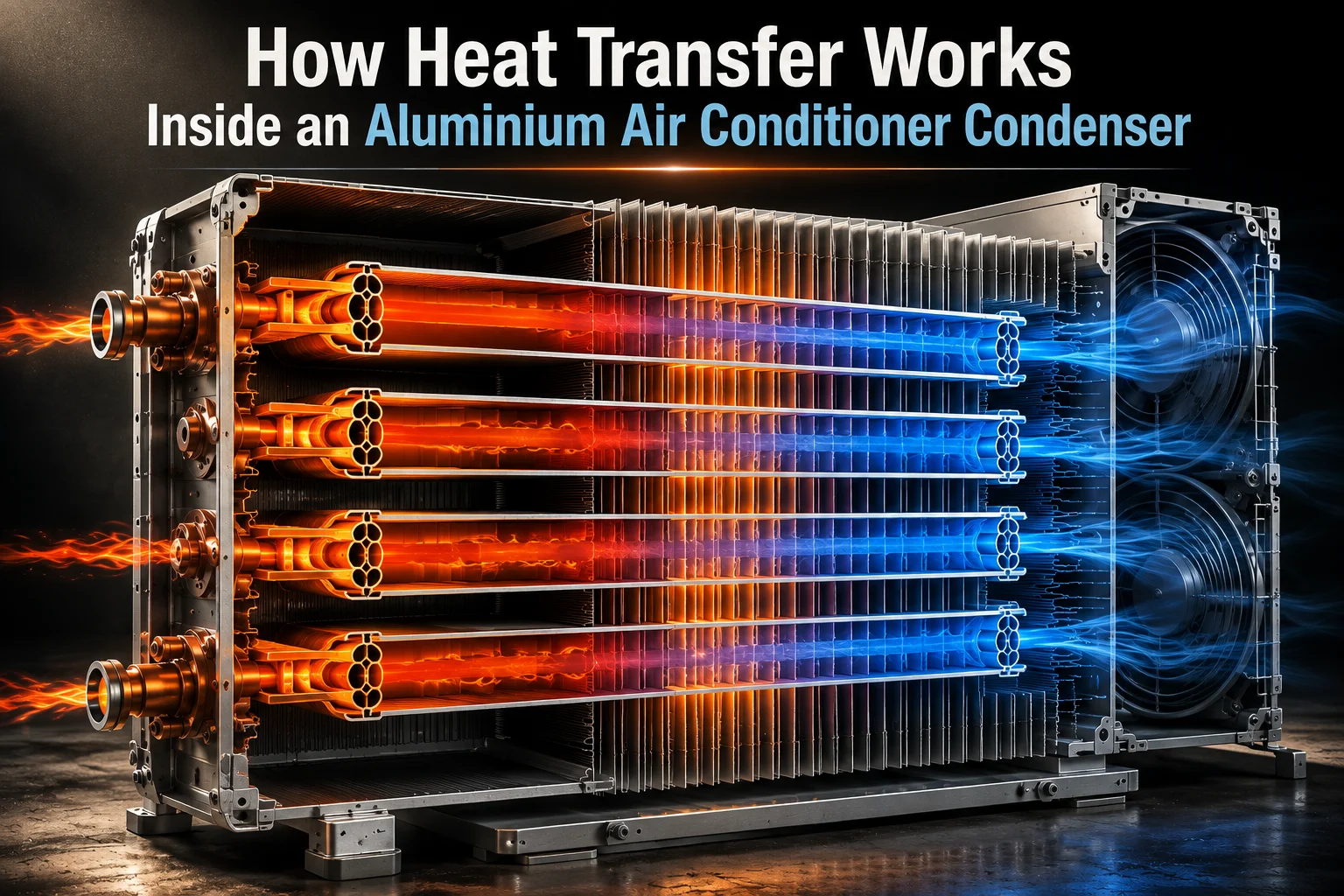
Modern air conditioning systems are expected to deliver powerful cooling while consuming less energy. Behind this performance is one critical component that often goes unnoticed—the aluminium AC condenser. While compressors and evaporators usually get the spotlight, the condenser plays an equally important role by releasing unwanted heat from the refrigerant and ensuring the entire cooling cycle runs efficiently.
But have you ever wondered how heat actually moves through an aluminium condenser? Understanding this process not only helps you appreciate the technology behind modern HVAC systems but also explains why proper condenser design and maintenance directly affect cooling performance, energy consumption, and equipment lifespan.
Let’s explore how heat transfer works inside an aluminium air conditioner condenser and why it has become the preferred choice for today’s HVAC industry.
What Is an Aluminium Air Conditioner Condenser?
An aluminium air conditioner condenser is a heat exchanger that transfers heat absorbed from indoor spaces to the outside atmosphere. It forms a vital part of the refrigeration cycle and works continuously whenever an air conditioner is operating.
A typical condenser consists of:
- Aluminium tubes carrying high-pressure refrigerant
- Thin aluminium fins that increase heat transfer surface area
- Fans that draw ambient air across the coil
- Headers that distribute refrigerant evenly throughout the system
Together, these components work to remove heat quickly and efficiently, allowing the refrigerant to cool down and return to the indoor unit to repeat the cooling process.
Understanding Heat Transfer in Simple Terms
Heat always moves from a hotter object to a cooler one.
Inside an air conditioning system, the refrigerant absorbs heat from the indoor environment. By the time it reaches the condenser, it is hot and under high pressure.
The condenser’s job is simple:
Remove that heat as quickly as possible.
The faster this happens, the more efficiently the entire HVAC system operates.
Modern condensers achieve this through three heat transfer mechanisms:
- Conduction
- Convection
- Forced airflow
Working together, these processes ensure rapid heat rejection even during high outdoor temperatures.
Step 1: Hot Refrigerant Enters the Condenser
After leaving the compressor, the refrigerant enters the condenser as a hot, high-pressure gas.
Temperatures can often range between 70°C and 90°C, depending on system design and operating conditions.
At this stage, the refrigerant contains all the heat collected from the indoor environment, plus additional heat generated during compression.
Step 2: Heat Moves Through the Aluminium Tubes
As the refrigerant flows through the aluminium tubes, heat transfers from the hot refrigerant to the tube walls through thermal conduction.
Aluminium is an excellent engineering material because it combines:
- High thermal conductivity
- Low weight
- Excellent corrosion resistance
- Easy manufacturability
These properties allow heat to move rapidly from the refrigerant to the outer surface of the condenser.
Step 3: Aluminium Fins Increase Heat Dissipation
The tubes alone would not provide enough surface area for efficient cooling.
That’s why manufacturers attach hundreds of thin aluminium fins between the tubes.
These fins dramatically increase the total heat transfer area—often by 10 to 20 times compared to the tubes alone.
The larger the surface area, the faster heat can escape into the surrounding air.
This is one of the primary reasons why modern aluminium Air Conditioner condenser designs deliver significantly better cooling performance while remaining compact and lightweight.
Step 4: Fans Remove Heat from the Coil
Large condenser fans continuously pull outside air across the aluminium fins.
This process is called forced convection.
As cooler air passes over the hot fins:
- Heat transfers into the airflow.
- The refrigerant temperature drops.
- The refrigerant changes from a high-pressure gas into a high-pressure liquid.
Without adequate airflow, heat transfer slows dramatically, forcing the compressor to run longer and consume more electricity.
Research indicates that restricted airflow can reduce condenser efficiency by up to 25%, highlighting the importance of clean coils and unobstructed ventilation.
Why Aluminium Is Replacing Copper
For decades, copper dominated condenser manufacturing.
Today, aluminium has become the preferred material for many HVAC applications because it offers several practical advantages.
Lightweight Construction
Aluminium weighs roughly one-third as much as copper, making installation easier and reducing transportation costs.
Better Corrosion Resistance
Aluminium naturally forms a protective oxide layer that helps resist corrosion in many operating environments.
Faster Manufacturing
Modern manufacturing technologies such as microchannel construction allow aluminium condensers to be produced with greater precision while reducing material usage.
Lower Refrigerant Volume
Many aluminium condenser designs require less refrigerant than traditional fin-and-tube systems, improving efficiency while lowering environmental impact.
What Affects Heat Transfer Efficiency?
Even the best-designed condenser can lose performance if operating conditions aren’t ideal.
Several factors influence heat transfer efficiency.
Dirty Condenser Fins
Dust and debris create an insulating layer that prevents heat from escaping.
Studies show that even a thin layer of dirt can reduce heat transfer efficiency by 15–20%.
Restricted Airflow
Blocked air inlets, damaged fans, or poor installation reduce cooling capacity and increase compressor workload.
Refrigerant Problems
Incorrect refrigerant charge limits the amount of heat reaching the condenser, reducing overall system performance.
Corrosion
Although aluminium is corrosion resistant, harsh industrial or coastal environments can gradually reduce heat transfer if proper protective coatings are not used.
Regular maintenance keeps these issues under control while maintaining peak system performance.
How Modern Microchannel Condensers Improve Heat Transfer
One of the biggest advancements in HVAC technology is the microchannel condenser.
Instead of traditional round tubes, microchannel designs use multiple flat aluminium channels that create a much larger heat transfer surface.
Benefits include:
- Faster heat rejection
- Improved airflow
- Lower refrigerant charge
- Compact design
- Better fuel and energy efficiency
These advantages have made microchannel technology increasingly popular across automotive, commercial, and industrial cooling applications.
Why Manufacturing Quality Matters
Heat transfer performance depends not only on material selection but also on manufacturing precision.
Factors such as tube geometry, fin spacing, brazing quality, and pressure testing all influence long-term reliability.
Choosing an experienced Aluminium air conditioner condenser manufacturer India ensures that every condenser is engineered for maximum thermal performance, durability, and consistent quality.
At NBR Cooling Systems, advanced manufacturing processes, rigorous testing, and continuous research enable the production of high-performance condenser solutions that meet demanding HVAC and industrial cooling requirements. Every product is designed to deliver efficient heat transfer, reliable operation, and long service life under diverse Indian operating conditions.
Tips to Maintain Efficient Heat Transfer
To keep your condenser operating at peak efficiency:
- Clean condenser fins every 3–6 months
- Maintain proper refrigerant levels
- Keep at least 600–1200 mm of clearance around outdoor units
- Inspect fan motors regularly
- Remove debris restricting airflow
- Schedule annual professional inspections
Routine maintenance helps reduce energy consumption while extending equipment life.
Final Thoughts
Heat transfer inside an air conditioner may seem complex, but the principle is straightforward—remove heat quickly and efficiently.
An aluminium AC condenser achieves this through a combination of highly conductive aluminium tubes, expanded fin surfaces, and continuous airflow. Together, these components ensure the refrigerant releases heat efficiently before beginning the next cooling cycle.
As energy efficiency becomes increasingly important, aluminium condensers continue to replace traditional alternatives because they are lighter, more durable, corrosion resistant, and capable of delivering outstanding thermal performance.
Whether you’re designing a new HVAC system or upgrading an existing one, choosing a high-quality condenser from a trusted manufacturer can significantly improve long-term reliability and operating efficiency. With decades of engineering expertise, NBR Cooling Systems continues to develop advanced condenser solutions that help businesses achieve dependable cooling performance across residential, commercial, automotive, and industrial applications.
Frequently Asked Questions
How does an aluminium air conditioner condenser transfer heat?
It transfers heat from the hot refrigerant to the surrounding air using conduction through aluminium tubes, expanded fin surfaces, and forced airflow generated by condenser fans.
Why is aluminium preferred over copper in modern condensers?
Aluminium is lightweight, corrosion resistant, cost-effective, and compatible with advanced microchannel designs that improve heat transfer while reducing refrigerant usage.
What reduces heat transfer efficiency in a condenser?
Dirty fins, restricted airflow, low refrigerant charge, fan failure, corrosion, and poor maintenance are the most common causes of reduced condenser performance.
How often should an aluminium condenser be cleaned?
Most commercial and industrial systems should be cleaned every 3–6 months, while installations in dusty or coastal environments may require more frequent maintenance.
Why choose NBR Cooling Systems?
NBR Cooling Systems combines over four decades of manufacturing expertise with advanced engineering, quality testing, and application-specific design to deliver reliable, high-performance condenser solutions for demanding HVAC and industrial applications.