
Why the HVAC Industry Is Shifting Toward Aluminium Condensers
Posted on July 31, 2026
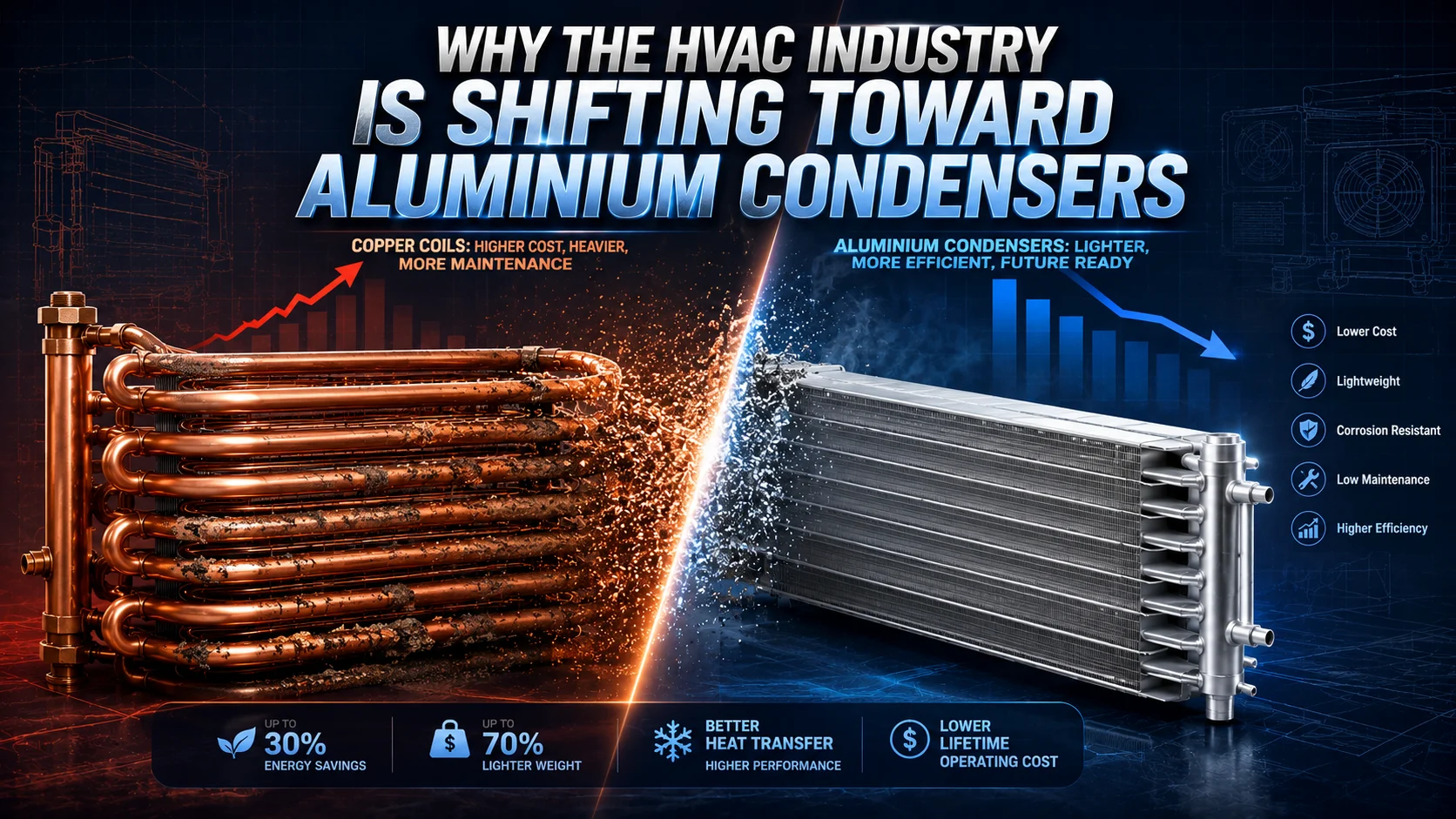
For decades, copper was the preferred material for HVAC heat exchangers. It offered excellent thermal conductivity, reliable performance, and strong corrosion resistance. However, if you visit a modern HVAC manufacturing facility today, you’ll notice a significant change—aluminium condensers are becoming the preferred choice.
This isn’t simply a cost-cutting trend. It’s a long-term industry shift driven by rising copper prices, advancements in microchannel technology, improved efficiency, and evolving environmental standards.
Let’s look at what’s driving this transition.
1. Rising Copper Prices Are Reshaping Manufacturing
One of the biggest reasons behind the shift is economics.
Copper prices have increased by approximately 18% through 2026, and since copper traditionally accounts for 40–60% of the raw material cost of manufacturing heat exchangers, these price increases significantly impact production costs.
Industry experts also expect supply constraints to keep copper prices elevated, making manufacturers look for more cost-effective alternatives.
Aluminium presents a compelling solution because it offers:
- Lower material costs
- Reduced manufacturing expenses
- Lighter overall system weight
- Better material efficiency
Unlike copper, aluminium isn’t just less expensive per kilogram. It also delivers a much higher surface area relative to its weight.
As a result, a well-engineered aluminium AC condenser can achieve cooling performance comparable to copper while using significantly less material.
2. Microchannel Technology Changed Everything
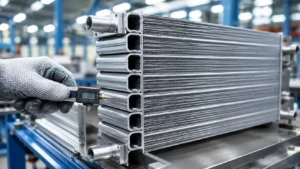
While lower material costs helped accelerate aluminium adoption, the real breakthrough came with microchannel condenser technology.
Traditional condensers typically use:
- Copper tubes
- Aluminium fins
Microchannel condensers follow an entirely different design.
Instead of round copper tubes, they use:
- Flat aluminium tubes
- Multiple parallel micro-sized refrigerant channels
- A completely aluminium construction
This isn’t just a small design improvement—it fundamentally changes condenser performance.
Benefits of Microchannel Technology
Compared to conventional finned-tube condensers, microchannel designs can provide:
- Around 55% less heat exchange surface area
- 20–40% higher overall system efficiency
- Lower refrigerant charge
- Reduced system weight
- Improved heat transfer performance
These improvements explain why HVAC manufacturers are redesigning product lines around aluminium instead of treating it as a lower-cost substitute.
3. Aluminium Offers Better Corrosion Performance Than Many Expect
Many people still assume copper performs better simply because it’s traditionally considered more durable.
However, modern testing tells a more balanced story.
Independent salt spray corrosion testing has shown that aluminium microchannel coils can perform approximately 40% better than conventional copper-tube designs under certain testing conditions.
That said, application matters.
For installations located in:
- Coastal regions
- High-humidity environments
- Highly corrosive industrial settings
Protective coatings remain essential for aluminium systems to ensure long-term durability.
Copper still maintains excellent natural corrosion resistance when left untreated, but modern coated aluminium condensers have proven they can perform exceptionally well in demanding environments.
4. The Automotive Industry Already Proved This Transition Works
The HVAC industry isn’t the first to replace copper with aluminium.
The automotive industry made the same transition decades ago.
One of the earliest examples was Volkswagen, which introduced aluminium tubing in vehicle radiators during the early 1990s.
Today:
- Most automotive radiators are aluminium.
- Aluminium dominates modern automotive cooling systems.
- The industry successfully moved away from copper years ago.
HVAC manufacturers are now following a very similar path by expanding aluminium usage across condensers, evaporators, and other heat exchange components.
5. What This Means for HVAC Buyers
If you’re purchasing or specifying HVAC equipment today, it’s important to understand that aluminium should no longer be viewed as simply the “budget option.”
A properly engineered aluminium AC condenser can deliver advantages that include:
- Higher energy efficiency
- Lower operating costs
- Reduced equipment weight
- Competitive long-term performance
- Lower material consumption
However, product quality remains critical.
Poorly engineered aluminium condensers may experience issues such as:
- Fin damage
- Thin-wall vibration sensitivity
- Microchannel clogging
- Reduced long-term reliability
This is why choosing an experienced condenser manufacturer for HVAC applications is often more important than simply choosing between copper and aluminium.
Engineering quality directly affects long-term performance.
6.Where NBR Cooling Systems Fits In
At NBR Cooling Systems, the transition to aluminium isn’t viewed as a simple material replacement.
Every aluminium condenser is engineered around proven microchannel technology to maximize efficiency, durability, and long-term performance.
Instead of focusing only on reducing manufacturing costs, NBR emphasizes:
- Advanced microchannel condenser design
- Performance-driven engineering
- Comprehensive product testing
- Reliable HVAC and refrigeration solutions
For businesses considering aluminium condensers for their next HVAC or refrigeration project, partnering with an experienced manufacturer ensures you benefit from the technology’s full potential rather than simply switching materials.
Final Thoughts
The HVAC industry’s move toward aluminium condensers is supported by real-world engineering and economic factors—not marketing hype.
Several key developments are driving this transition:
- Sustained increases in copper prices
- Significant efficiency gains through microchannel technology
- Reduced equipment weight
- Lower refrigerant requirements
- Proven success in the automotive industry
For today’s buyers, the question is no longer whether aluminium deserves consideration.
The real question is whether you’re sourcing your aluminium condenser from a manufacturer with the engineering expertise to fully deliver on the technology’s advantages. That’s where experienced manufacturers like NBR Cooling Systems make the difference.
FAQ’s
Is aluminium as good as copper for HVAC condensers?
Often better, when properly engineered. Microchannel aluminium condensers can deliver 20-40% higher efficiency than traditional copper designs while using less material by weight.
Why is copper becoming more expensive for HVAC manufacturers?
Copper prices have risen roughly 18% through 2026 due to global supply constraints, and since copper makes up 40-60% of raw material costs in heat exchangers, this has pushed manufacturers toward aluminium.
Does aluminium corrode faster than copper?
Copper has stronger natural corrosion resistance untreated, but properly coated aluminium microchannel coils have shown around 40% better performance in salt spray testing. Coastal or humid environments still need proper protective coating.
What is a microchannel condenser, and how is it different?
It’s built entirely from aluminium using flat tubes with many small parallel channels instead of round copper tubing with aluminium fins — reducing required surface area by around 55% while improving heat transfer.
Has any other industry already made this same shift?
Yes — automotive did decades ago. Volkswagen began switching to aluminium radiator tubing in the early 1990s, and most car radiators are aluminium today.
Should I choose an aluminium condenser for my next HVAC project?
For most modern applications, yes. The bigger factor is choosing an experienced condenser manufacturer who understands microchannel engineering, since build quality determines whether you actually get aluminium’s performance benefits.