
5 Cooling System Mistakes That Are Quietly Costing Manufacturers Money
Posted on July 29, 2026
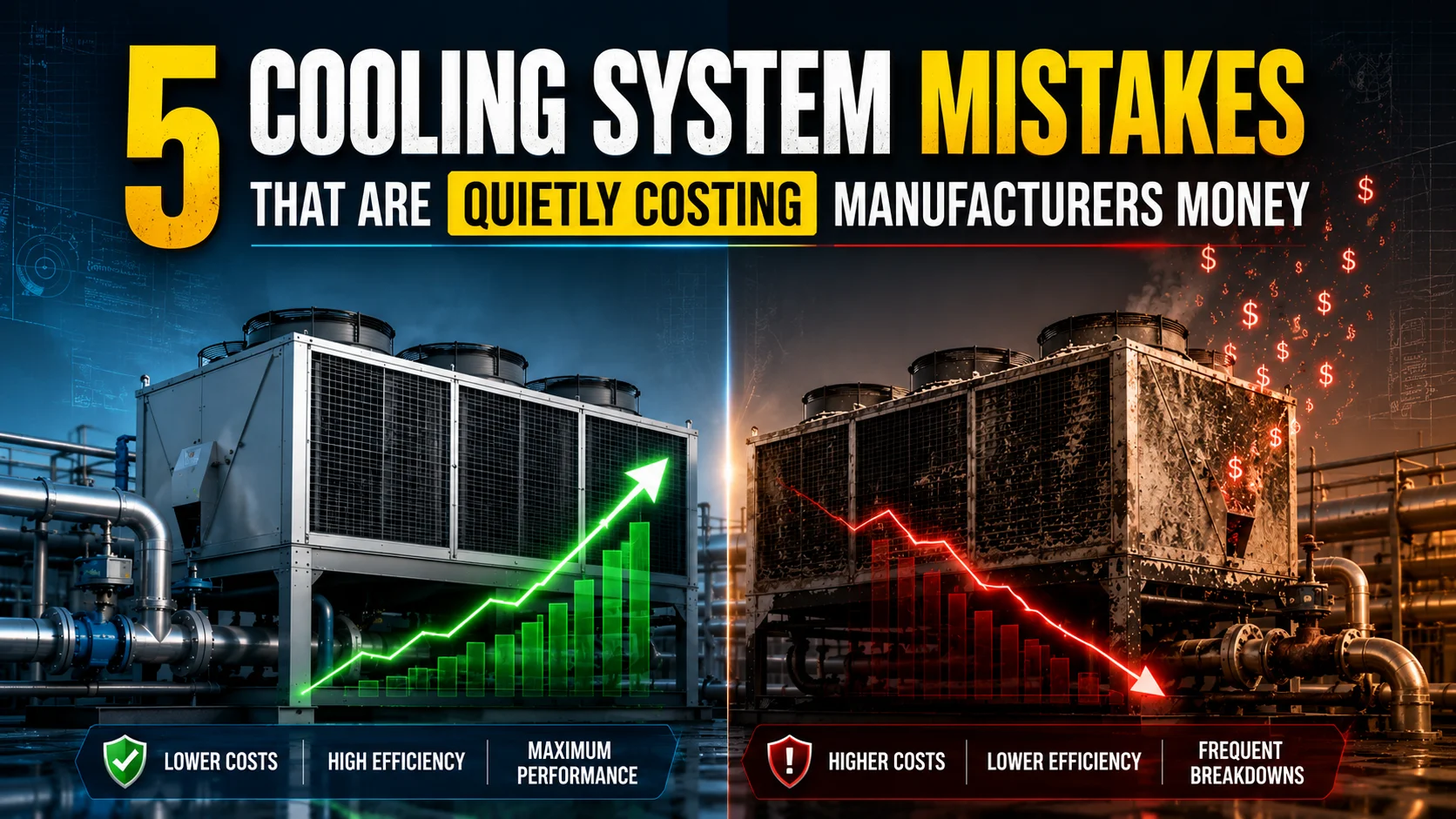
In manufacturing, every minute of downtime and every unnecessary kilowatt-hour adds to operating costs. A poorly maintained Cooling System doesn’t always fail dramatically—it often loses efficiency gradually, driving up energy bills, increasing maintenance expenses, and reducing equipment life without attracting immediate attention.
According to the U.S. Department of Energy, industrial motors account for roughly 69% of electricity used in manufacturing, and cooling-related equipment such as chillers, condensers, and cooling towers represents a significant share of that consumption in many facilities. Even a small decline in cooling efficiency can translate into thousands of dollars in avoidable operating costs over a year.
Here are five common mistakes that quietly drain profits—and how to avoid them.
1. Ignoring Routine Heat Exchanger and Condenser Cleaning
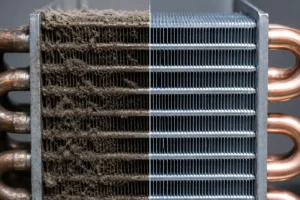
Dust, grease, scale, and airborne contaminants gradually build up on heat transfer surfaces. As deposits increase, the equipment must work harder to remove the same amount of heat.
The result?
- Higher compressor workload
- Longer operating cycles
- Increased electricity consumption
- Reduced production efficiency
Industry studies have shown that even 0.8 mm (1/32 inch) of fouling on heat transfer surfaces can reduce heat transfer efficiency significantly and increase energy consumption. For many industrial systems, dirty heat exchangers can increase energy usage by 10–30%, depending on operating conditions.
Best Practice
Schedule inspections based on your operating environment instead of waiting for visible performance issues. Facilities operating in dusty, humid, or chemical-processing environments often require more frequent cleaning than standard annual maintenance.
2. Using an Undersized or Oversized Cooling Solution
Many manufacturers choose equipment based primarily on purchase price rather than long-term operating requirements.
An undersized system often leads to:
- Continuous operation
- Higher equipment temperatures
- Frequent shutdowns
- Reduced component life
An oversized system creates different problems:
- Short cycling
- Poor humidity control
- Unnecessary energy consumption
- Increased maintenance
Proper thermal load calculations consider:
- Ambient temperature
- Process heat generation
- Operating hours
- Future production expansion
- Equipment diversity factor
Investing in the correct capacity often reduces operating costs for years.
3. Delaying Small Repairs Until They Become Major Failures
A minor refrigerant leak.
A noisy fan.
An abnormal vibration.
A clogged filter.
These issues rarely stop production immediately, making them easy to ignore.
However, they usually develop into expensive failures.
Research from industrial maintenance organizations consistently shows that planned maintenance typically costs far less than emergency repairs, while unplanned downtime can cost manufacturers thousands—or even tens of thousands—of dollars per hour, depending on the industry.
Routine inspections allow maintenance teams to identify:
- Bearing wear
- Fan imbalance
- Refrigerant loss
- Loose electrical connections
- Corrosion
before they become production-stopping failures.
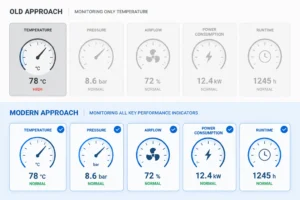
4. Monitoring Temperature Instead of Overall System Performance
Many facilities only react when temperatures exceed acceptable limits.
Unfortunately, by then efficiency has already declined.
Modern facilities increasingly monitor additional performance indicators such as:
- Power consumption (kW)
- Refrigerant pressure
- Airflow
- Water flow rate
- Compressor runtime
- Condensing temperature
- Pump efficiency
These metrics help maintenance teams identify performance degradation weeks—or even months—before a breakdown occurs.
Predictive maintenance has become one of the most effective ways to reduce unexpected downtime while improving energy efficiency.
5. Choosing Equipment Based Only on Initial Price
The cheapest option isn’t always the most economical.
Industrial cooling equipment often operates 24 hours a day, 365 days a year.
A unit that saves money during purchase may consume substantially more electricity over its lifetime.
When evaluating equipment, manufacturers should consider:
- Energy efficiency
- Heat transfer performance
- Material quality
- Corrosion resistance
- Spare parts availability
- Service support
- Expected operating life
The total cost of ownership almost always provides a better investment comparison than purchase price alone.
This is why many businesses work with experienced Cooling System manufacturers in India that can recommend solutions based on operational requirements rather than simply offering standard products.
Why Preventive Cooling Management Pays Off
Well-maintained industrial cooling systems deliver measurable business benefits beyond temperature control.
Facilities that prioritize preventive maintenance often experience:
- Lower electricity consumption
- Longer equipment lifespan
- Fewer emergency shutdowns
- Improved production consistency
- Reduced maintenance expenses
- Better process reliability
Instead of reacting to failures, proactive maintenance helps manufacturers control costs while protecting productivity.
Final Thoughts
Hidden cooling inefficiencies rarely appear overnight. They develop gradually through neglected maintenance, improper equipment selection, and overlooked performance issues. Over time, these small problems can lead to significant increases in energy consumption, maintenance costs, and production losses.
Working with experienced engineering partners such as NBR Cooling Systems can help manufacturers identify the right cooling solutions, improve thermal performance, and build systems designed for long-term operational efficiency. Investing in proactive maintenance and well-engineered equipment today can prevent costly surprises tomorrow.
FAQ’s
How much energy does a dirty heat exchanger actually waste?
Depending on the level of fouling and operating conditions, a dirty heat exchanger can increase energy consumption by roughly 10–30%. Even a thin layer of buildup — well under a millimeter — is enough to noticeably reduce heat transfer efficiency and force the system to work harder for the same cooling output.
How often should industrial cooling equipment be inspected?
There’s no single fixed interval — it depends on the environment. Facilities in clean, low-dust conditions can often stick to annual inspections, while dusty, humid, or chemical-processing environments typically need checks every 3–6 months to catch fouling and wear before they affect performance.
Is it cheaper to repair or replace industrial cooling equipment?
It depends on repair frequency and cost trends over time. As a general rule, once annual repair costs start climbing and approaching a meaningful share of replacement cost, it’s usually more economical to replace the unit than keep patching it — especially since older, less efficient equipment also costs more to run in the meantime.
What’s the real cost of unplanned cooling system downtime?
This varies heavily by industry, but unplanned downtime in manufacturing can cost anywhere from a few thousand to tens of thousands of dollars per hour, depending on the scale of production affected. That’s why planned, preventive maintenance almost always costs less in the long run than reactive emergency repair.
How do I know if my cooling system is oversized or undersized?
Undersized systems tend to run continuously, struggle to hit target temperatures, and shut down frequently. Oversized systems short-cycle — turning on and off rapidly — which wastes energy and causes poor humidity control. Both patterns are signs the original sizing didn’t match the actual thermal load, and a proper load calculation (accounting for ambient temperature, process heat, and operating hours) is the fix.
What percentage of a manufacturing facility’s electricity bill comes from motors and cooling equipment?
According to the U.S. Department of Energy, industrial motor systems — which power compressors, pumps, fans, and much of the cooling infrastructure in a facility — account for roughly 69% of electricity used in industrial operations, making cooling-related equipment one of the largest controllable costs in most plants.
What is predictive maintenance, and does it actually save money?
Predictive maintenance means tracking performance indicators — like power draw, refrigerant pressure, airflow, and condensing temperature — instead of just watching for temperature alarms. It typically catches efficiency loss weeks or months before a breakdown, which is why it’s increasingly used to cut both energy waste and emergency repair costs.
Does the cheapest cooling equipment actually save money long-term?
Not usually. Since industrial cooling equipment often runs continuously year-round, a unit that’s cheaper upfront but less energy-efficient can cost significantly more over its operating life than a higher-quality option. Total cost of ownership — not purchase price — is the more accurate way to compare equipment.