
What Is the Difference Between an Industrial Condenser and a Cooling Tower?
Posted on July 20, 2026
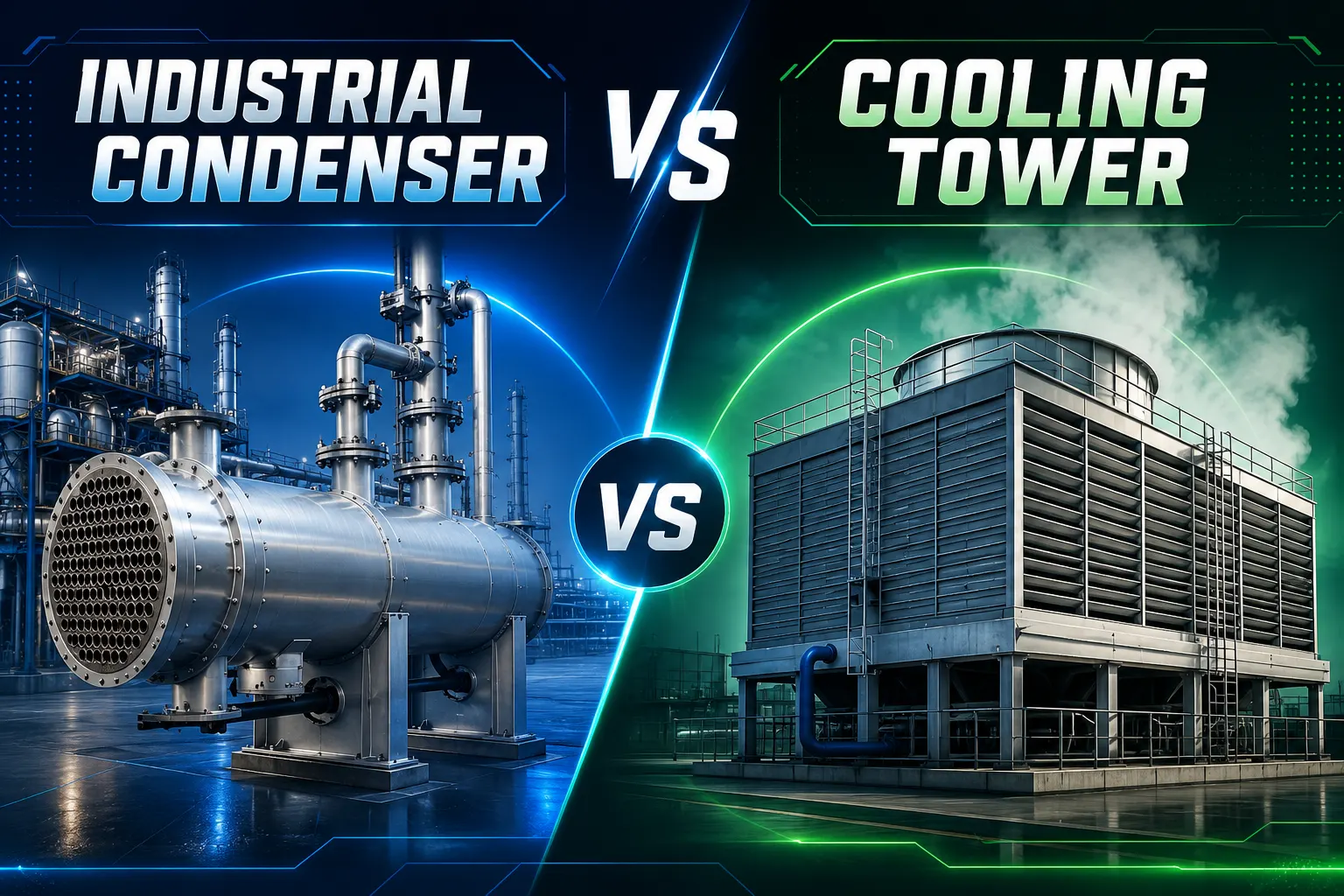
Industrial cooling systems rely on several components working together to remove heat efficiently, and two of the most important are the Industrial condenser and the cooling tower. Because both deal with heat rejection, they’re often confused with one another — but they perform entirely different jobs and are built for different parts of the cooling process.
Understanding this difference matters for anyone selecting equipment, sizing a system, or troubleshooting inefficiency. Whether you’re designing a new refrigeration line, upgrading an HVAC setup, or running a manufacturing facility, knowing exactly what each component does — and where it fits in the cycle — makes the difference between a system that runs efficiently and one that wastes energy.
In this article, we’ll break down how condensers and cooling towers actually work, where each is used, and when a facility needs one, the other, or both together.
What Is an Industrial Condenser?
A Industrial condenser is a heat exchanger that converts refrigerant or process vapor from a high-temperature gas into a liquid by removing heat from it. This phase change is what completes the refrigeration cycle — without it, refrigerant can’t return to the evaporator to absorb heat again.
Rather than cooling air or water directly, a condenser pulls heat out of the refrigerant using air, water, or a combination of both as the cooling medium. Depending on design, condensing temperatures typically run somewhere in the 90–130°F range above ambient, with the exact figure depending on refrigerant type, load, and coil design.
Where condensers are used:
- Industrial HVAC systems
- Refrigeration plants
- Cold storage facilities
- Chemical processing
- Pharmaceutical manufacturing
- Food and beverage processing
- General process cooling
Since the condenser is doing the actual heat-rejection work at the core of the cycle, coil material, airflow design, and refrigerant compatibility all directly affect long-term efficiency — which is why sourcing from a manufacturer with real application experience matters more here than with almost any other component in the system.
What Is a Cooling Tower?
A cooling tower is a heat-rejection structure designed to cool warm process water so it can be recirculated back into industrial operations.
Unlike a condenser, a cooling tower doesn’t condense refrigerant at all. Instead, it lowers water temperature through evaporative cooling — a small percentage of the circulating water (typically 1–2% per cooling cycle) evaporates as it passes over the tower’s fill media, and that evaporation pulls heat out of the remaining water.
Where cooling towers are used:
- Power plants
- Steel and metal manufacturing
- Chemical and petrochemical processing
- Large commercial buildings
- Industrial manufacturing facilities
Their job is to keep large volumes of circulating water at a usable temperature while minimizing the energy needed to do it — which is why they’re standard equipment anywhere large-scale heat rejection is involved.
Condenser vs. Cooling Tower: Quick Comparison
| Feature | Condenser | Cooling Tower |
| Primary Purpose | Converts refrigerant vapor into liquid by removing heat | Removes heat from circulating water through evaporation |
| Working Principle | Transfers heat from refrigerant to air or water via heat exchange | Uses evaporative cooling to reduce water temperature |
| Medium Being Cooled | Refrigerant or process gases | Water |
| Main Function | Completes the refrigeration cycle | Rejects heat from process water |
| Common Applications | HVAC, refrigeration, cold storage, pharma, food processing | Power plants, chemical plants, manufacturing, commercial buildings |
| Cooling Method | Air-cooled or water-cooled heat exchange | Evaporative cooling using airflow + water circulation |
| Typical Maintenance | Coil cleaning, refrigerant charge checks, leak testing | Water treatment, scale/biofilm control, fan and fill inspection |
Can a Condenser and Cooling Tower Work Together?
Yes — and in many industrial refrigeration systems, they’re designed to work as a pair rather than as alternatives.
Here’s how the combined cycle typically runs:
- The condenser removes heat from the refrigerant, condensing it back into a liquid.
- That heat is transferred to a separate water loop (in water-cooled condenser systems).
- The now-warm water is pumped to the cooling tower.
- The cooling tower rejects that heat into the atmosphere through evaporation.
- The cooled water returns to the condenser, and the cycle repeats.
This setup is common in large-scale plants because it lets the condenser stay compact and efficient while the cooling tower handles the heavier job of dumping large volumes of waste heat outdoors — something an air-cooled condenser alone often can’t do as efficiently at scale.
Which One Does Your Facility Actually Need?
| If your requirement is… | Recommended solution |
| Condensing refrigerant in an HVAC or refrigeration system | Condenser |
| Cooling large volumes of process water | Cooling tower |
| Cold storage or refrigeration facility | Condenser |
| Power generation or heavy manufacturing | Cooling tower |
| Large industrial refrigeration plant | Both, working together |
The better question usually isn’t “which is better” — it’s which stage of your cooling process each one needs to handle. In smaller refrigeration setups, a condenser alone may be all you need. In larger plants with significant water-cooled loads, both components typically end up working together.
Why NBR Cooling Systems for Your Condenser Needs
Choosing the right condenser is only half the equation — the manufacturer behind it matters just as much, since coil design, material selection, and build quality determine how the unit performs over years of continuous operation, not just on day one.
NBR Cooling Systems manufactures industrial condensers built for demanding HVAC, refrigeration, and process-cooling applications, with engineering focused on airflow efficiency, coil durability, and refrigerant compatibility across a range of system sizes. Beyond the equipment itself, NBR works directly with customers to size and specify the right condenser for their specific load and application — rather than offering a one-size-fits-all unit — backed by responsive after-sales support to minimize downtime once the system is running.
For facilities planning a new installation or replacing aging equipment, that combination of application-specific engineering and ongoing support is what separates a condenser that performs reliably for years from one that becomes a maintenance headache.
Final Thoughts
A condenser and a cooling tower both play essential roles in industrial cooling, but they’re not interchangeable — one condenses refrigerant to complete the refrigeration cycle, the other rejects heat from circulating water through evaporation. In many large-scale systems, they’re not competing solutions at all, but two stages of the same heat-rejection loop.
Understanding exactly what each component does — and where your system actually needs one, the other, or both — is the first step toward building a cooling setup that runs efficiently and holds up over the long term. Working with an experienced Industrial condenser manufacturer during that planning stage is what turns that understanding into a system that actually performs as designed.
FAQ’s
What is the difference between an industrial condenser and a cooling tower?
An industrial condenser removes heat from refrigerant by converting it from a high-pressure vapor into a liquid, while a cooling tower removes heat from circulating water through evaporative cooling. In many industrial systems, both work together, but they perform different functions within the cooling process.
Can a cooling tower replace an industrial condenser?
No, a cooling tower cannot replace an industrial condenser because they perform different functions within the cooling system.
Can an industrial condenser and a cooling tower work together?
Yes, in water-cooled systems, an industrial condenser and a cooling tower work together to remove and reject heat efficiently.
Which industries require both a condenser and a cooling tower?
Industries such as food processing, pharmaceuticals, chemical manufacturing, refineries, and large HVAC or refrigeration plants commonly use both condensers and cooling towers.
How often should an industrial condenser be serviced?
|An industrial condenser should be inspected every 3–6 months and serviced at least once a year, depending on operating conditions.
Does a cooling tower improve the efficiency of a water-cooled condenser?
Yes, a cooling tower improves the efficiency of a water-cooled condenser by cooling the circulating water before it returns to the condenser.