
3 Types of Condensers Used in Industrial Refrigeration, and How to Pick the Right One
Posted on September 28, 2026
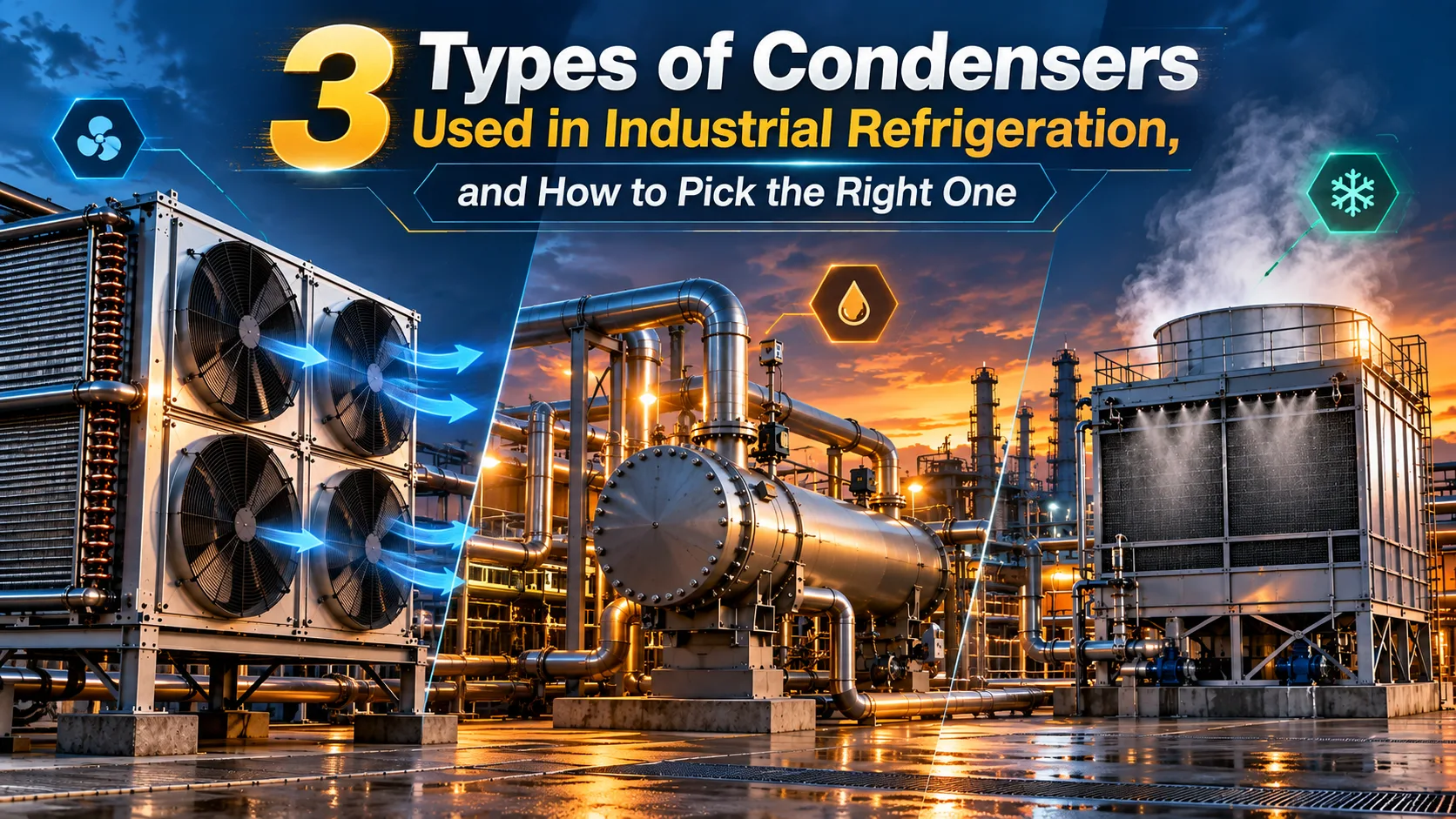
The three main types of condensers used in industrial refrigeration are water-cooled, evaporative and air-cooled condensers. Each rejects heat from the refrigerant in a different way, and the right choice depends mostly on your climate, your water supply, and your energy costs.
Here’s how they differ, and how to choose between them.
Why the Condenser Matters More Than You Think
Every refrigeration system has to move heat somewhere. The condenser is the component that dumps it. It takes hot, high-pressure refrigerant vapor from the compressor and turns it back into liquid by rejecting heat to air, water, or both.
The reason this decision carries so much weight is condensing temperature. A technical comparison published by one condenser manufacturer cites a commonly used rule of thumb: every 1 K increase in condensing temperature costs roughly 2 to 3% more compressor power at a fixed evaporating temperature. Treat that as an approximation, since real figures depend on the compressor and refrigerant. The direction is well established, though: a condenser that keeps condensing temperature low saves energy every hour the plant runs.
The 3 Types at a Glance
| Air-Cooled | Water-Cooled | Evaporative | |
| How it rejects heat | Fans move ambient air over finned coils | Refrigerant condenses against water, usually recirculated through a cooling tower | Water is sprayed over the coil while air is pulled across it |
| Water needed? | None | Yes, a constant supply | Yes, but far less than once-through water cooling |
| Limited by | Dry-bulb air temperature | Cooling water temperature | Wet-bulb air temperature |
| Upkeep | Lowest: keep coils clean | Water treatment, cooling tower or water system | Water treatment, cleaning, monitoring |
| Best fit | Water-scarce sites, simpler plants | Sites with reliable, affordable water | Large industrial systems in hot climates |
1. Air-Cooled Condensers
How they work: Hot refrigerant flows through finned tubes while fans push ambient air across them. Heat moves from the refrigerant into the air. No water is involved.
Where they shine:
- Sites where water is scarce, expensive, or restricted
- Plants that want minimal maintenance and no water-treatment program
- Locations where a cooling tower or spray system isn’t practical
The trade-off: Air-cooled units are limited by the dry-bulb temperature of the surrounding air, and on hot days that pushes condensing temperature up. That means more compressor power. One manufacturer’s technical comparison notes that in a humid coastal summer, the gap between an air-cooled unit (which chases dry-bulb) and an evaporative unit (which approaches wet-bulb) can reach 8 to 12 K of condensing temperature.
2. Water-Cooled Condensers
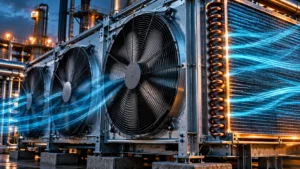
How they work: Refrigerant condenses inside a heat exchanger while water carries the heat away. That water is typically recirculated through a cooling tower rather than used once and discharged.
Where they shine:
- Facilities that already have reliable, affordable cooling water
- Applications that need consistently low condensing temperatures
The trade-off: They need a steady water supply, plus the equipment and treatment that come with it. Industry sources describe them as more costly to install and maintain than air-cooled units.
3. Evaporative Condensers
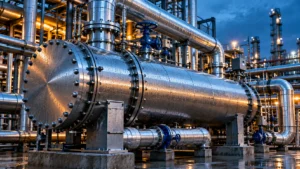
How they work: Water is sprayed over the condenser coil while a fan draws air across it. Some of that water evaporates, and evaporation absorbs a large amount of heat. This is why evaporative units can reach lower condensing temperatures than air-cooled equipment on the same duty.
Where they shine:
- Large industrial refrigeration systems in warm or hot climates
- Plants that want lower energy use than air-cooled, without the water demand of once-through cooling
The trade-off: They still use water, and they need water treatment, regular cleaning, and monitoring. A manufacturer-published comparison also warns that sites with an interruptible summer water supply shouldn’t rely on evaporative heat rejection alone during peak season without a dry backup.
The Fourth Option Worth Knowing: Hybrid (Adiabatic) Condensers
Engineers increasingly talk about a hybrid design that runs dry most of the year and switches on water spray only during the hottest hours. Academic research supports the appeal: a 2026 study of adiabatic condensers found they improved energy efficiency in every climate region studied, but with the drawback of higher on-site water consumption. Hybrid units also tend to carry the highest capital cost of the group, so they usually make sense only where both water and peak electricity are expensive.
The Oil Cooler Condenser Connection Most Guides Skip
There’s a second heat-rejection story running inside many industrial systems, and it affects condenser sizing.
Screw compressors use oil to seal, cool, and lubricate. That oil gets hot, so it passes through an oil cooler before returning to the compressor. Oil coolers can use different cooling media:
- Thermosiphon (refrigerant-cooled): Liquid refrigerant from the system absorbs heat from the oil and returns as vapor to the condenser, where it is condensed again. Many practitioners regard this as the state-of-the-art approach for its efficiency.
- Water- or glycol-cooled: A secondary fluid absorbs the oil’s heat and rejects it elsewhere.
- Air-cooled: A fan pushes air across the oil cooler’s surfaces.
- Liquid injection: Refrigerant is injected into the compressor to control discharge temperature, which can remove the need for an oil cooler altogether.
Why this matters for your condenser choice: with thermosiphon oil cooling, the oil’s heat ends up at the condenser. Engineering guidance notes that a condenser can be sized to carry both the compressor’s heat of rejection and the oil cooling load. So when you specify a condenser, specify the oil cooling method with it. Sizing one without the other is a common source of underperformance.
How to Choose: 6 Questions to Ask First
- What does your climate look like?
Compare dry-bulb and wet-bulb design temperatures. A large gap favors evaporative cooling. A small gap narrows the advantage. - How available and affordable is water?
Water cost, supply reliability, and discharge permits often outweigh pure energy math. - What does electricity cost?
The higher your power price, the more a lower condensing temperature is worth. - Who will maintain it?
Water-based systems need treatment programs and routine cleaning. Air-cooled units mostly need clean coils. - What refrigerant are you using?
Air-cooled condensing has traditionally been paired with halocarbons, but IIAR-published research has compared evaporative and air-cooled condensing for ammonia systems across six U.S. cities, challenging that default assumption. - How will the oil cooling load be handled?
As covered above, it can change the condenser duty.
Where NBR Cooling Systems Fits In
NBR Cooling Systems, based in Indore, India, focuses on the air-cooled side of this picture. Its range includes aluminium and MCHX condensers, along with oil coolers and other heat exchangers. Air-cooled condensers suit applications where water is limited or where a compact, low-maintenance heat-rejection solution matters.
Whichever type you’re considering, a good Refrigeration Condenser Manufacturer will ask about your operating conditions before recommending anything. Come prepared with:
- Heat rejection duty and refrigerant type
- Ambient design temperatures (dry-bulb and wet-bulb)
- Available space and airflow constraints
- Your oil cooling method and load
- Water availability and cost
The Bottom Line
There’s no universally best condenser, only the best fit for your climate, water supply, energy costs, and maintenance capacity. Start with the site conditions, include the oil cooling load in the sizing conversation, and choose the type that keeps condensing temperature low without creating a water or upkeep problem you can’t sustain.
FAQ’s
What are the three types of condensers used in industrial refrigeration?
Air-cooled, water-cooled, and evaporative condensers.
Which condenser type is most energy efficient?
It depends on the site. Evaporative condensers can reach lower condensing temperatures than air-cooled units because they take advantage of evaporative cooling, and one manufacturer’s analysis found evaporative heat rejection used significantly less energy than air-cooled or adiabatic alternatives. The efficiency gain comes with water use, so a site-specific calculation is essential.
Which type uses no water?
Air-cooled condensers.
Can air-cooled condensers work in hot climates?
Yes, but condensing temperature rises with ambient temperature, which increases compressor power. Adiabatic (hybrid) assist is one way to reduce that penalty.
What does an oil cooler do in a refrigeration system?
In screw compressor systems, it removes heat from the lubricating oil so the oil can keep sealing, cooling, and lubricating the compressor.
Does the oil cooler affect condenser sizing?
It can. In thermosiphon oil cooling, the oil’s heat is returned to the condenser, so the condenser can be sized to handle both the compressor’s heat of rejection and the oil cooling load.
What is a hybrid or adiabatic condenser?
A condenser that runs dry when conditions allow and uses water spray only during the hottest hours, balancing energy savings against water use.